Every delivery business faces the same challenge: how to move packages from origin to destination efficiently and reliably. If you have ever tracked a shipment that stopped at a major sorting facility before reaching its final address, you have already seen this system in action. So, what is hub and spoke model, and why does it matter in modern logistics?
The hub and spoke model is a distribution structure where shipments pass through a central hub before being routed onward. At Bearcat Express, we help businesses understand how this approach affects delivery speed, cost, flexibility, and overall reliability.
What Is Hub and Spoke Model?
To answer clearly: what is the hub and spoke model in logistics?
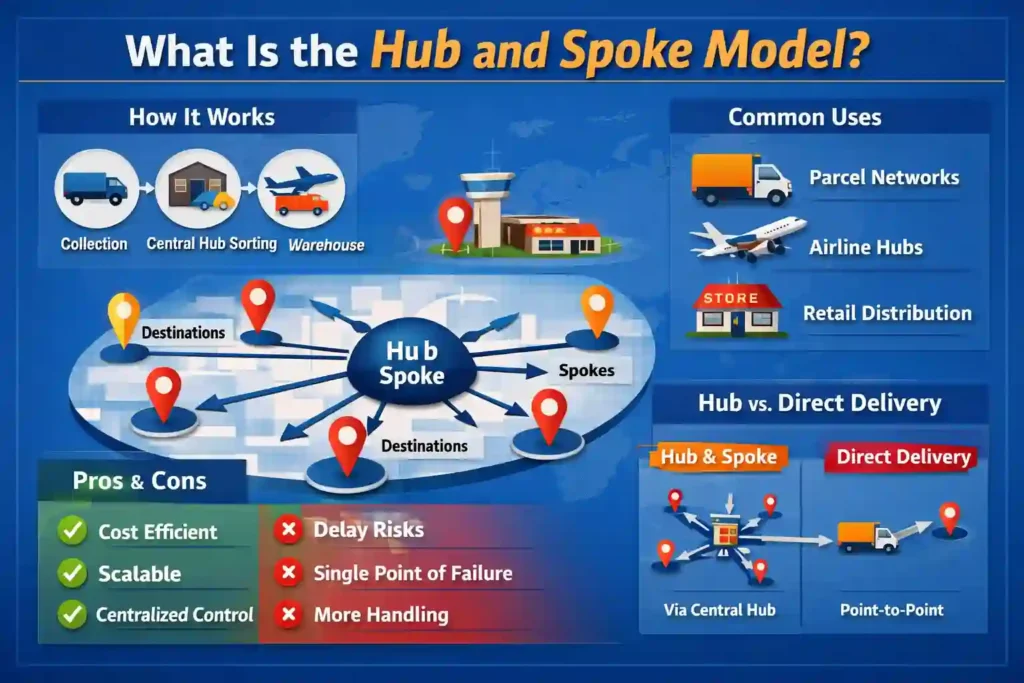
The hub and spoke system is a network structure where:
- A central distribution center (the hub) receives shipments.
- Regional routes (spokes) connect outwards to multiple destinations.
- Goods move from sender → hub → final location.
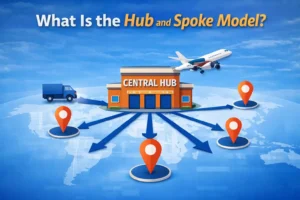
Think of a wheel. The center is the hub. The outer lines extending from it are spokes. This is why it is sometimes called the spoke and wheel model.
In a transportation context, the hub spoke model consolidates shipments at a primary facility, where they are sorted and redistributed. This system allows companies to reduce the number of direct routes needed between cities.
A Simple Real-World Example
Imagine a retailer shipping orders nationwide. Instead of sending trucks directly between every pair of cities, all shipments go to one major sorting facility. From there, they are redistributed outward. That central point ensures efficiency at scale.
This is the core hub and spoke model, meaning: centralization for efficiency.
How the Hub and Spoke System Works in Transport
Understanding how the hub and spoke system functions in practice helps clarify its strengths and limitations.
1. Collection Phase
Packages are collected from customers and transported to a regional or national hub. This may involve multiple pickup vehicles gathering shipments throughout the day.
2. Central Sorting
At the hub, shipments are scanned, categorized, and grouped by destination. Advanced sorting systems streamline this process, reducing routing complexity.
3. Redistribution
Once sorted, goods are dispatched along designated spokes to their final cities or distribution centers. From there, they may enter a last-mile delivery stage.
The advantage of the hub spoke model is that it reduces route duplication. Instead of managing dozens of direct connections between cities, all shipments route through a single core facility.
Where the Hub and Spoke Model Is Commonly Used
The hub and spoke business model appears across multiple industries.
National Parcel Carriers
Large courier networks rely heavily on hub centralization. Their operational scale makes direct point-to-point shipping inefficient. The hub and spoke system allows them to move millions of parcels daily while maintaining predictable routing.
Airline Networks
Airlines pioneered the spoke and wheel model in aviation. Major airports serve as hubs, with regional airports functioning as spokes. Passengers frequently connect through central airports instead of flying directly.
Retail Distribution
Retailers operating multiple storefronts frequently use a central warehouse hub. Inventory moves from suppliers to the hub, then flows outward to individual stores based on demand forecasting and inventory control systems.
For businesses evaluating local delivery alternatives, companies like Bearcat Express help clarify when a centralized hub system makes sense and when direct routing may provide better results.
In all these cases, the hub and spoke model offers scalability, structured control, and predictable movement of goods across large networks.
Advantages of the Hub and Spoke Model
Businesses choose the hub and spoke system for several practical reasons.
Cost Reduction
By consolidating shipments, companies minimize the need for direct routes between every location. Fewer routes mean lower fuel costs and streamlined fleet operations.
Centralized Control
A central hub simplifies inventory tracking and operational oversight. Management can monitor volume, route optimization, and processing in one location.
Scalability
As shipment volume increases, the network can expand by adding more spokes without redesigning the entire system. This flexibility is a major advantage of the hub spoke model.
Predictable Routing
Standardized flow patterns allow consistent scheduling and forecasting.
Disadvantages and Operational Risks
Despite its strengths, the hub and spoke model is not perfect.
Single Point of Failure
If the hub experiences disruption from weather events, mechanical breakdowns, or staffing shortages, every connected spoke may be affected.
Processing Delays
Because shipments pass through a central sorting facility, there is an added handling stage. For urgent deliveries, this can increase total transit time.
Increased Handling
Each additional transfer introduces risk. Packages may be scanned, sorted, moved, and reloaded multiple times before final delivery.
This is why understanding what is hub and spoke model also means recognizing where it may not be ideal.
Hub and Spoke vs Direct Delivery Model
For local courier services, the key comparison is between hub routing and direct delivery.
| Feature | Hub and Spoke Model | Direct Delivery Model |
| Routing | Through the central hub | Straight to the recipient |
| Handling | Multiple touchpoints | Minimal handling |
| Speed | Efficient at scale | Faster locally |
| Best For | National distribution | Time-sensitive local deliveries |
In urgent scenarios such as legal documents, medical items, or same-day business shipments, direct routing often outperforms centralized processing.
Why Many Local Same-Day Couriers Use Direct Routing
While the hub and spoke system works well for national networks, many local courier companies choose a different strategy for time-sensitive shipments.
Direct routing eliminates the extra stop at a central hub. That means:
- Faster turnaround
- Lower risk of misrouting
- Reduced handling damage
For example, businesses searching for a reliable Same Day Delivery Service in Augusta, GA often need speed above all else. In such cases, bypassing a central sorting stage ensures packages move immediately from pickup to drop-off.
At Bearcat Express, local deliveries frequently move directly from sender to recipient without intermediate stops. This approach improves accountability and reduces delays that sometimes occur in larger hub-based networks.
Understanding the difference between the hub and spoke model and direct delivery empowers businesses to choose the right method for their specific needs.
You may also read: Is Tissue Paper Good for Shipping Clothes?
Choosing the Right Distribution Strategy for Your Business
Selecting a logistics strategy depends on three factors:
- Geographic scope
- Shipment urgency
- Volume scale
If your company ships nationwide in high volume, the hub and spoke business model may offer cost efficiency and centralized oversight.
If your operations depend on fast, local delivery within a defined region, direct routing may provide better service consistency.
There is no universal answer to what is the hub and spoke model as a solution for every business. The model works best when aligned with shipment type and operational goals.
Real-World Insight from Courier Operations
Businesses often assume bigger networks equal faster delivery. In reality, routing complexity can slow urgent shipments. The spoke and wheel model prioritizes scale efficiency, not necessarily individual speed.
Local courier providers understand neighborhood routing patterns, traffic conditions, and time-sensitive scheduling. This practical experience helps determine when a centralized hub approach is appropriate and when a direct route is smarter.
Evaluating the hub and spoke model meaning within your own operational context ensures you avoid overengineering simple deliveries.
Final Thoughts
So, what is hub and spoke model? It is a structured distribution framework designed to centralize sorting and streamline large-scale transportation. It delivers efficiency and scalability, particularly for national networks.
However, it is not the only solution. Direct routing often provides greater speed for local and urgent shipments. The key is understanding which system aligns with your business priorities.
If you are evaluating shipping strategies or need dependable local courier support, contact us at Bearcat Express to discuss the right delivery approach for your operations.
FAQs
- What is the hub and spoke model in simple terms?
The hub and spoke model is a distribution system where shipments move through a central hub before reaching their final destination. It reduces route complexity and centralizes sorting.
- How does the hub and spoke system differ from direct shipping?
In a hub and spoke system, packages pass through a central facility. Direct shipping moves items straight from sender to receiver, often reducing transit time for local deliveries.
- What is the hub and spoke business model used for?
The hub and spoke business model is commonly used in logistics, airlines, and retail distribution to manage large volumes efficiently through centralized control.
- Is the spoke and wheel model good for same-day delivery?
It can work at scale, but for urgent local deliveries, direct routing is often faster because it avoids extra sorting stages.
- Why do companies use the hub spoke model?
Companies use the hub-and-spoke model to reduce operational costs, simplify network management, and expand distribution efficiently across wide geographic areas.