Shipping frozen meat isn’t something you can leave to guesswork. Whether you’re sending steaks to family, fulfilling online orders, or transporting bulk protein, one question matters most: how long will dry ice keep meat frozen during transit? A wrong estimate can mean spoilage, food safety risks, and financial loss.
At Bearcat Express, customers often ask whether dry ice alone is enough. It can be highly effective, but only when used correctly and matched with realistic delivery times. Understanding how dry ice works, how long it lasts, and when faster local shipping makes sense helps prevent costly, avoidable mistakes.
Quick Answer: How Long Will Dry Ice Keep Meat Frozen?
In most standard shipping conditions:
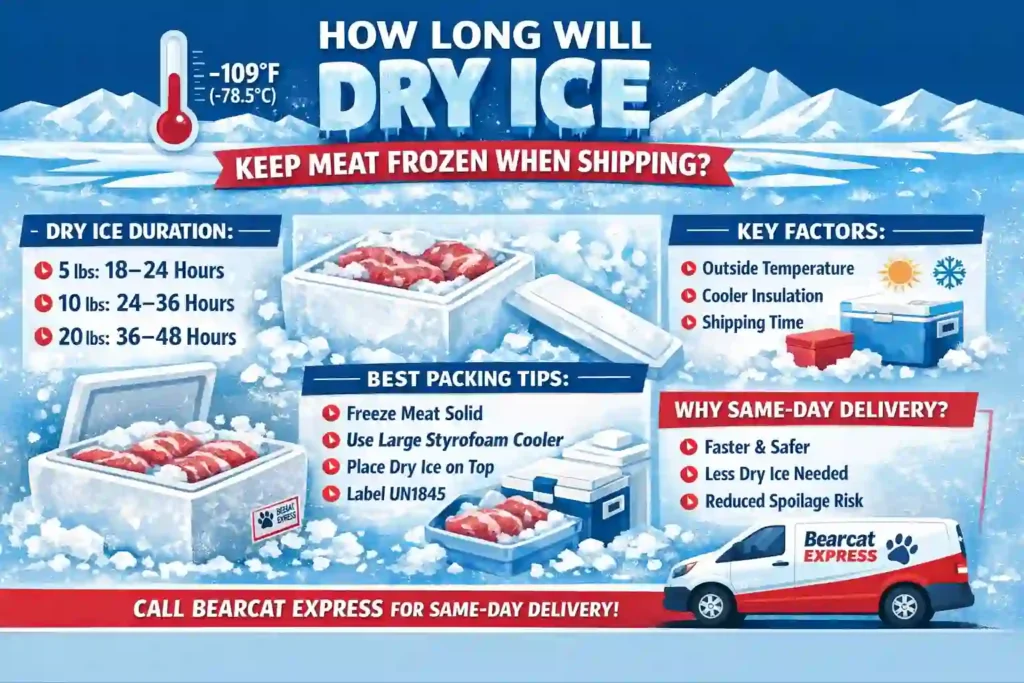
- 5 pounds of dry ice keeps meat frozen for about 18–24 hours
- 10 pounds lasts roughly 24–36 hours
- 20 pounds can last 36–48 hours
Those numbers assume the meat is fully frozen, packed tightly, and stored in insulated containers like large styrofoam coolers placed inside a sturdy outer box. For local shipments, providers like Bearcat Express often see even better temperature control when delivery windows are limited to the same day, reducing the total time dry ice needs to perform.
If you’re asking how long will dry ice keep things frozen in general, the answer depends on insulation quality, outside temperature, and air space inside the container. Dry ice doesn’t “melt”; it sublimates (turns directly into gas), which means once it’s gone, temperature protection disappears quickly.
How Dry Ice Works for Shipping Frozen Food
Dry ice is solid carbon dioxide (CO₂) with a temperature of –109.3°F (–78.5°C). That extreme cold is why it’s so effective for shipping frozen food with dry ice.
Unlike gel packs that gradually warm, dry ice maintains extremely low temperatures until it fully sublimates. That makes it ideal for:
- Raw meat
- Game meat
- Seafood
- Meal prep products
- Bulk protein shipments
If you’re wondering how long does dry ice keep things frozen compared to gel packs, it typically maintains lower temperatures longer, especially when paired with insulated large styrofoam coolers.
However, it evaporates steadily, typically 5–10 pounds every 24 hours in a standard cooler.
What Temperature Must Meat Stay At to Remain Safe?
According to the Food and Drug Administration, frozen meat should remain at 0°F (-18°C) or below to maintain safety and quality.
Once temperatures rise above 40°F, bacteria can multiply rapidly. Even if meat still “feels cold,” partial thawing can weaken texture, reduce shelf life, and increase food safety risk.
This is why focusing only on insulation materials isn’t enough. The more important question is whether your cooling method will outlast the entire transit time, including unexpected delays, carrier slowdowns, or weather disruptions.
That’s where many frozen shipments fail.
How Long Does Dry Ice Last in a Styrofoam Cooler?
When people ask how long does dry ice last in a styrofoam cooler, the answer depends heavily on the cooler’s thickness and size.
In general:
- Small cooler (thin walls): 5 lbs lasts ~18 hours
- Medium cooler: 10 lbs lasts ~24–36 hours
- Thick-wall, large styrofoam coolers: 20 lbs can reach 48 hours
Air space is the hidden factor. If the cooler isn’t tightly packed, warm air accelerates sublimation. Properly filled coolers significantly extend protection time.
If you’re planning on shipping frozen meat, invest in heavy-duty, large styrofoam coolers, not lightweight picnic versions.
Factors That Affect How Long Dry Ice Keeps Meat Frozen
Understanding how long will dry ice keep things frozen requires evaluating several real-world variables:
1. Outside Temperature
Shipping in summer heat reduces effective duration. Warm ambient air increases the sublimation rate.
2. Shipping Duration
Two-day shipping is predictable. A three-day economy with sorting delays is not.
3. Insulation Quality
Thicker walls mean slower gas escape and better cold retention.
4. Meat Density
Dense, fully frozen cuts retain cold longer than loosely packed ground meat.
5. Handling Frequency
Opening the container destroys temperature stability.
If you’re serious about the best way to ship frozen meat, minimizing transit time is often more important than simply adding more dry ice.
The Best Way to Ship Frozen Meat (Step-by-Step)
Here’s a proven method used in professional shipping frozen meat operations:
- Freeze meat completely solid (at least 24–48 hours beforehand).
- Vacuum seal or double-wrap tightly.
- Use thick, large styrofoam coolers.
- Place dry ice on top (cold air sinks downward).
- Fill the space with insulation material.
- Do not seal airtight; dry ice needs ventilation.
- Label the package properly (UN1845 for dry ice).
This method significantly improves how long will dry ice keep meat frozen during shipping.
Is Shipping Frozen Food With Dry Ice Legal?
Yes, but it must comply with regulations.
The United States Department of Transportation classifies dry ice as a hazardous material due to CO₂ gas release. If shipped via mail, USPS requires proper labeling and ventilation.
Most ground carriers allow it, but air shipments have stricter rules.
If you’re frequently shipping frozen food with dry ice, ensure compliance to avoid delays or rejected packages.
When Dry Ice Alone Isn’t Enough
Dry ice is reliable but only within realistic timeframes.
It may not be enough if:
- Transit exceeds 48 hours
- Shipping cross-country during hot weather
- International transit with customs delays
- Using thin insulation
In these cases, the smarter solution isn’t adding 30 pounds of dry ice. It’s reducing transit time.
That’s why businesses often shift from national carriers to trusted local logistics providers.
Why Faster Delivery Reduces Risk
When customers ask how long dry ice will keep meat frozen, they’re usually trying to “calculate safety.” But temperature control is only part of the equation.
Shorter delivery windows mean:
- Less sublimation
- Less temperature fluctuation
- Lower spoilage risk
- Reduced need for excessive dry ice
For example, a 6–8 hour delivery window requires far less insulation planning than a 48-hour transit.
That’s one reason why local producers increasingly rely on Same Day Delivery Service in Augusta, GA, for time-sensitive food transport.
Real-World Scenario: Local Shipping vs Multi-Day Transit
Imagine a butcher shop shipping 25 pounds of premium steaks:
Option A:
48-hour parcel shipping
20 lbs dry ice
Risk of delay
Higher packaging cost
Option B:
Local same-day courier
5–10 lbs dry ice
Controlled delivery window
Lower risk
When evaluating how long does dry ice keep things frozen, remember that reliability improves dramatically when transit time shrinks.
At Bearcat Express, businesses using our Same Day Delivery Service in Augusta, GA, reduce spoilage concerns by eliminating long transit windows. Instead of depending entirely on dry ice endurance, they rely on controlled timing.
You may also read: Which Type of Transport is Suitable for Fragile Goods?
Common Mistakes When Shipping Frozen Meat
Even experienced shippers make avoidable errors:
- Using too little dry ice
- Leaving air gaps inside the cooler
- Sealing the container airtight
- Choosing economy 2–3 day shipping
- Failing to pre-freeze meat completely
These mistakes shorten how long dry ice will keep meat frozen sometimes by half.
The best way to ship frozen meat is to combine proper insulation with realistic delivery timelines.
Final Thoughts
So, how long will dry ice keep meat frozen? In ideal conditions, 24–48 hours. But successful shipping frozen meat depends just as much on transit time and insulation quality as it does on dry ice quantity.
For local businesses and individuals, reducing delivery time often provides more protection than increasing dry ice weight. That’s why many food producers turn to Bearcat Express when dependable, time-sensitive transport matters.
If you need guidance on safe local delivery or want to explore the safest approach for perishable shipments, contact us today. Reliable timing protects your product and your reputation.
Frequently Asked Questions
How long does dry ice last in a styrofoam cooler during summer?
Heat accelerates sublimation. Expect a 10–20% reduction in duration. If shipping frozen meat in warm climates, consider faster transit options.
What is the best way to ship frozen meat safely?
The best way to ship frozen meat includes full pre-freezing, vacuum sealing, thick insulation, proper labeling, and minimizing transit time. Pairing dry ice with reliable scheduling significantly improves safety.
Can dry ice refreeze partially thawed meat?
No. Once meat enters the unsafe temperature zone, refreezing does not eliminate bacterial risk. Proper planning prevents this issue.
How long will dry ice keep things frozen compared to gel packs?
Dry ice maintains much lower temperatures and lasts longer in controlled conditions. For extended shipping frozen food with dry ice, it is typically more reliable than gel packs.