
At 2 a.m., a lab technician draws blood cultures from a critically ill patient. That sample cannot wait for the next scheduled pickup. It needs to reach the lab within minutes or results become unreliable. This is where STAT medical delivery makes the difference between a fast diagnosis and a dangerous delay.
If you have ever wondered what STAT medical delivery actually means and why hospitals, labs, and pharmacies depend on it, this guide explains it in plain language based on real field experience. Bearcat Express has handled these urgent runs for healthcare facilities across Georgia and Alabama, and understands what missed pickup windows can cost.
What Is STAT Medical Delivery?

STAT medical delivery is the transport of time-critical medical items such as lab specimens, medications, organs, or diagnostic equipment within a narrow window, often less than an hour. The word “STAT” comes from the Latin term “statim,” which means immediately. Doctors and nurses have used it for decades to flag orders that cannot wait in the normal queue.
When a hospital marks a delivery as STAT, it is telling the courier that this shipment takes priority over everything else on the route. At Bearcat Express, a stat courier does not treat this like a regular parcel drop. The item usually has a narrow viability window, meaning delays are not just inconvenient. They can compromise the sample or the treatment itself.
This is different from how the word gets used casually. In healthcare, STAT delivery meaning is specific and operational. It signals urgency tied directly to a patient’s condition, not just a business deadline.
STAT Delivery vs. Emergency & Same-Day Delivery
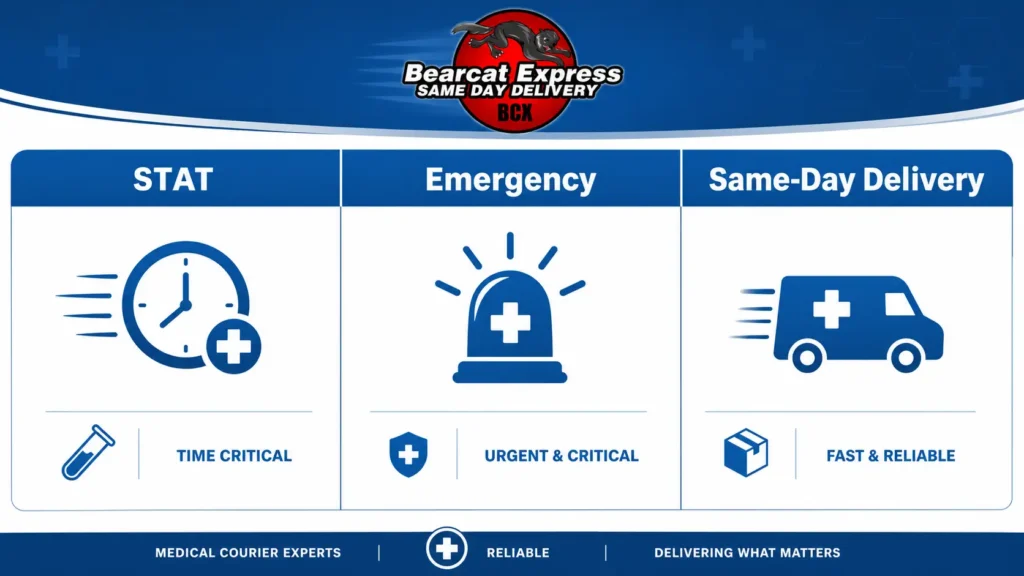
People often use these terms interchangeably, but they are not the same thing, and understanding the difference helps you order the right service the first time.
A same-day delivery guarantees the item arrives before the business day ends. That works fine for routine lab specimens, non-urgent prescription refills, or interoffice medical records that need to move but are not tied to an active emergency.
An emergency delivery is a broader term used across industries, not just healthcare. A law firm needing signed documents delivered immediately or a manufacturer needing a replacement part rushed to a job site would call that an emergency delivery.
A stat medical courier is specifically trained and dispatched for healthcare-related urgency. The timeframe is usually measured in minutes, the handling requirements are stricter, and the courier understands things like specimen viability, chain of custody, and HIPAA obligations that a general emergency courier may not be trained on. Knowing this distinction helps facility managers request the right level of service instead of overpaying for urgency they do not need, or underestimating urgency that truly requires a stat courier.
What Can Be Transported via STAT Medical Delivery
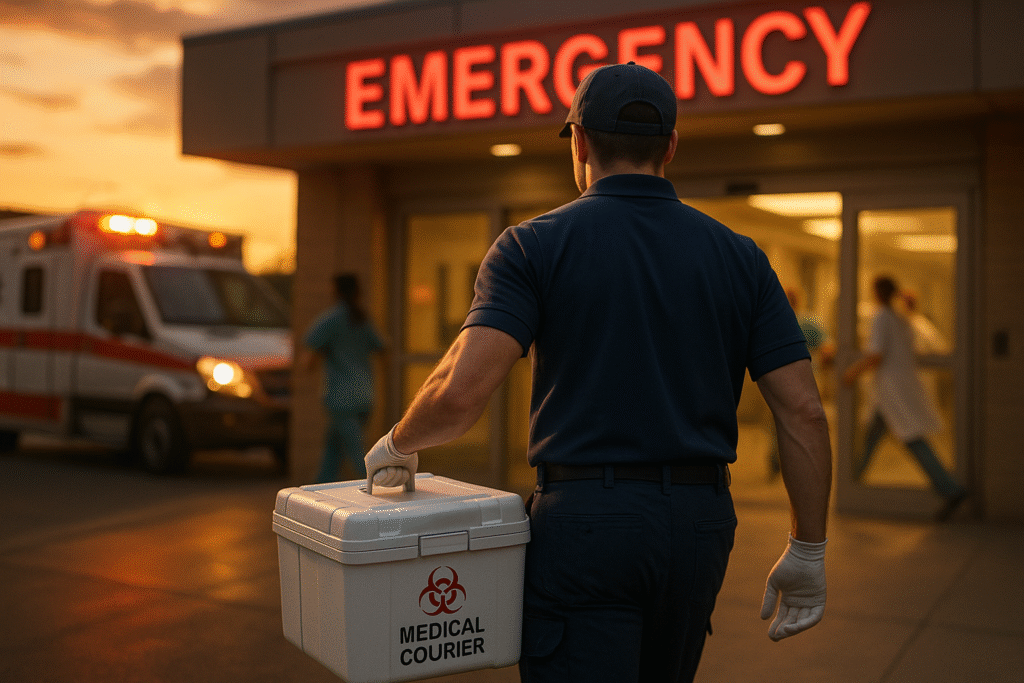
STAT deliveries cover a wide range of items, and each category comes with its own handling requirements.
Lab specimens make up a large share of stat delivery requests, including blood cultures, tissue biopsies, and pathology samples that need to reach a lab before they degrade. Medications, particularly antibiotics, antidotes, and time-sensitive infusions, often require STAT transport when a patient’s treatment cannot begin without them. Organs and tissue for transplant represent the most time-critical category, where minutes genuinely determine viability.
Medical equipment also falls under this category when a facility needs a device, such as an infusion pump or diagnostic tool, rushed to a location for an active procedure. Sensitive records, including imaging discs and physician orders, sometimes need STAT handling when a treatment decision depends on that documentation arriving immediately. Each of these items demands a different level of care, and a courier handling STAT work needs to understand which precautions apply to which cargo, rather than treating every delivery the same way.
Who Relies on STAT Medical Couriers
Hospitals & Emergency Rooms
Emergency departments generate the highest volume of STAT requests because patient conditions change quickly. A doctor ordering a STAT lab test expects results fast, which means the specimen transport has to move just as fast.
Medical Laboratories
Labs depend on STAT courier services to receive samples from multiple hospitals and clinics on tight timelines, then send results back out just as quickly. A single delayed pickup can back up an entire testing queue.
Pharmacies
When a patient needs a medication that a local pharmacy does not stock, or when a hospital pharmacy runs short on a critical drug, STAT delivery closes that gap before it affects patient care.
Hospice & Long-Term Care Facilities
Hospice teams often need medications or supplies delivered to a patient’s home or a care facility on short notice. STAT delivery lets patients stay comfortable in familiar surroundings instead of requiring transport to a hospital for something a courier could bring to them.
Why STAT Delivery Matters for Patient Care
Risks of Delayed Deliveries
A delayed STAT delivery is not just a logistics problem; it is a clinical one. Specimens that sit too long can degrade, medications that arrive late can push back treatment timelines, and equipment that shows up after a procedure has already started creates unnecessary risk for the patient and the care team.
Impact on Diagnosis & Treatment Timelines
Diagnosis speed often determines how quickly a physician can start the right treatment. Studies on hospital workflows have shown that reducing delays in medication and specimen transport directly improves how quickly patients receive appropriate care. A stat medical courier that consistently hits tight windows helps hospitals keep that chain moving.
Role of Cold Chain & Specimen Integrity
Many STAT items, especially blood products, vaccines, and certain lab specimens, need temperature-controlled transport. If a courier does not maintain the correct temperature range during transit, the item can lose viability even if it arrives on time. This is one of the most overlooked parts of STAT delivery, and it is where inexperienced couriers often fall short.
What Makes a STAT Delivery Successful
Three things determine whether a STAT delivery actually works the way it is supposed to.
Speed is the most obvious factor, but speed without care is not useful in healthcare logistics. A courier needs to move fast while still following proper handling procedures for whatever they are transporting.
Compliance matters just as much as speed. Anyone handling medical specimens, records, or patient-related items is functioning as a HIPAA business associate, which means confidentiality and proper documentation are not optional. A stat courier needs training on this, not just a fast vehicle.
Secure handling ties both of these together. Direct transport with minimal handoffs reduces the risk of contamination, damage, or lost chain of custody. The fewer touchpoints a package goes through, the lower the risk to its integrity.
How to Choose the Right STAT Medical Courier
Identify Your Delivery Pain Points
Before evaluating couriers, figure out what is actually going wrong. Are deliveries arriving late, are staff getting complaints, or is temperature control inconsistent? Knowing your specific problem helps you ask the right questions during vendor evaluation.
Check Real-Time Tracking Capabilities
A stat courier should offer live tracking so your team can see exactly where a delivery is at any point. This matters most when a physician is waiting on a specimen result or a nurse needs to know when medication will arrive.
Review On-Time Performance
Ask any potential courier partner for their actual on-time delivery rate, not a vague promise. A courier with a proven track record above 90 percent gives you something measurable to hold them to.
Confirm Cold Chain & Temperature Control Process
Ask specifically how they maintain temperature-sensitive cargo during transport. A courier that cannot explain their cold chain process in detail is not equipped to handle sensitive medical shipments reliably.
Verify Medical Field Experience & HIPAA Training
Experience in healthcare logistics is not optional. A courier without HIPAA training or prior medical delivery experience introduces compliance risk that most facilities cannot afford to take on.
You may also read: What is Linehaul Transportation
Bearcat Express’s Approach to STAT Medical Delivery in Georgia & Alabama

Bearcat Express has built its STAT medical delivery service around the realities that hospitals, labs, and pharmacies deal with every day. Our drivers receive HIPAA training before they ever handle a medical specimen or patient record, and every STAT run includes real-time GPS tracking so receiving facilities know exactly when to expect their delivery.
We understand the local roads, traffic patterns, and facility layouts across Augusta and the surrounding Georgia and Alabama region, which shaves minutes off routes that a courier unfamiliar with the area would lose. For facilities that need dependable urgent transport beyond STAT-specific runs, our Same Day Delivery Service Augusta GA page outlines how we handle time-sensitive shipments across the region, including the same attention to reliability that our STAT deliveries require.
Conclusion
Understanding what STAT medical delivery is helps healthcare facilities make faster, better decisions when patient care is on the line. From lab specimens to temperature-sensitive medications, a STAT medical courier plays a direct role in how quickly patients get diagnosed and treated.
Bearcat Express has spent years building the training, tracking systems, and local knowledge needed to handle these deliveries the right way across Georgia and Alabama. If your facility needs a dependable partner for STAT or same-day medical transport, contact us today to discuss how we can support your team.
FAQs
What is the difference between STAT delivery and rush delivery?
STAT delivery specifically refers to medical transport tied to patient care urgency, while rush delivery is a broader term used across industries for anything needing faster than standard shipping. A STAT medical courier is trained for healthcare-specific handling that a general rush courier may not have.
How fast is a typical STAT medical delivery?
Most STAT deliveries are completed within one hour, though some time-critical items like organs may require even faster transport. The exact timeframe depends on distance, item type, and the urgency level set by the ordering facility.
Do STAT couriers need special training?
Yes, a reliable STAT courier should have HIPAA training and experience handling medical specimens, since confidentiality and specimen integrity are just as important as speed. Couriers without this background can put both compliance and patient safety at risk.
Can individuals request a STAT medical delivery, not just hospitals?
Individuals can request STAT delivery for situations like getting a prescription to a homebound patient or family member who cannot pick it up themselves. This is common in hospice care, where getting medication to a patient’s home quickly matters as much as it does in a hospital setting.
What items commonly require STAT delivery?
Lab specimens, time-sensitive medications, medical equipment, and organs for transplant are among the most common items requiring STAT delivery. Each requires different handling, from temperature control to specialized packaging, depending on what is being transported.