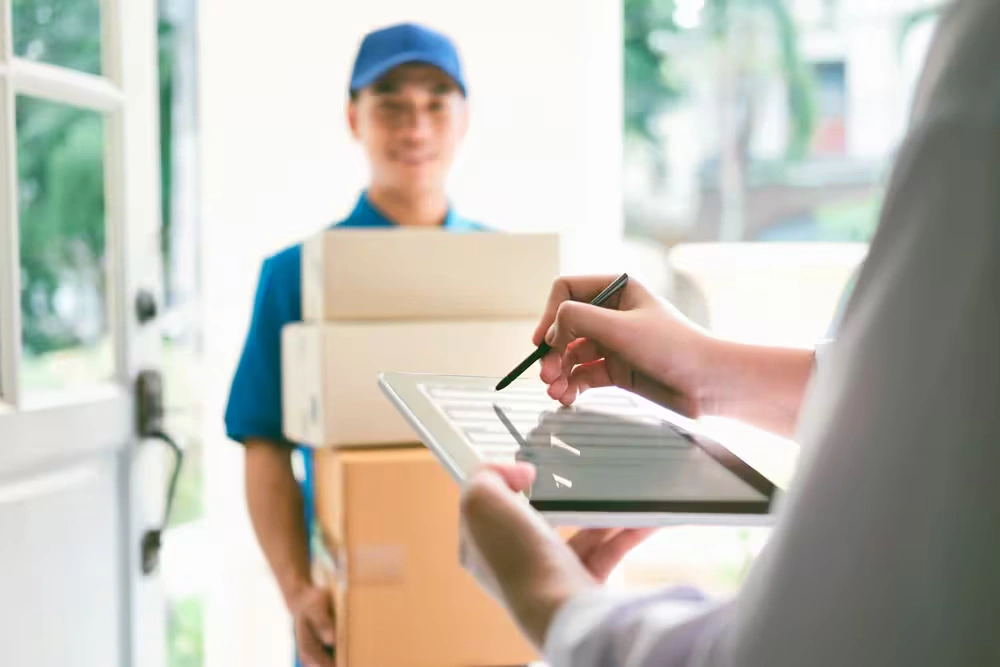
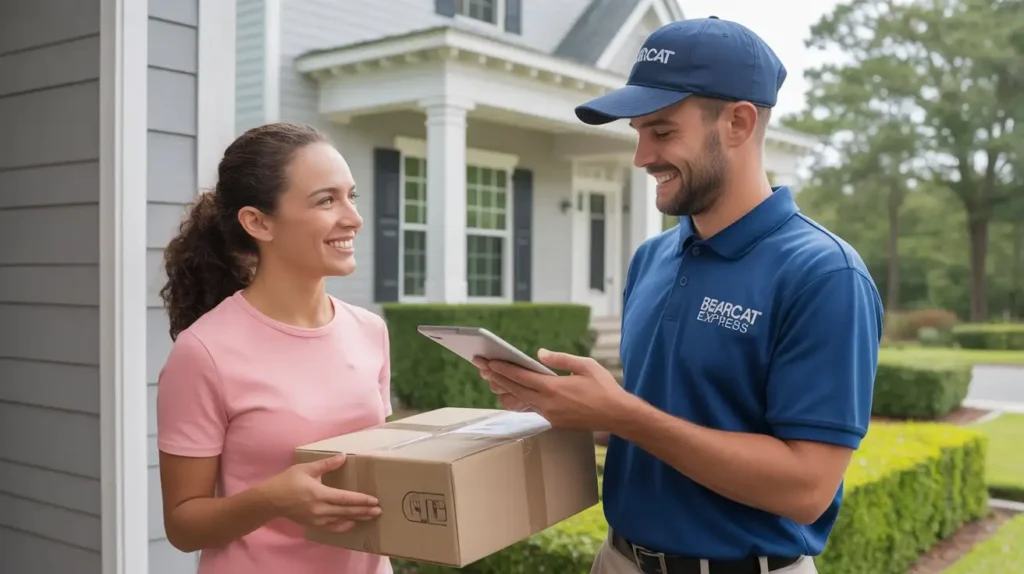
You check your tracking page, see “delivered to local courier,” and wonder whether the box is on your porch or lost somewhere. The wording confuses many people. What does delivered to local courier mean? It means your parcel has left the original carrier and been handed to a local delivery provider who will complete the final leg.
It does not mean the package reached your address. Usually, it is still a few scans away from your door. At Bearcat Express, a same-day courier in Augusta, GA, last-mile handoffs happen daily. This guide explains the status, the wait, and when to act.
What “Delivered to Local Courier” Means (Quick Answer)
A tracking status describes who has custody of your parcel, not how close it is to you. In this phrase, “delivered” refers to a handoff between two companies. The first company has finished its job and passed the parcel to a second company that knows the local streets.
You may see the same event written in different ways, such as “delivered to local carrier” or “received by local delivery company.” The delivered to local carrier meaning is identical in each case: one party is done, and another party now owns the next step.
Think of a hotel front desk. When a courier drops your package at the desk, the package has been delivered to the building, but it has not reached your room. The status works the same way. It tells you the parcel changed hands, and that is all it promises.
Which Situation Are You In? Three Scenarios
The same words can describe three very different situations. Working out which one applies to you is the fastest way to know whether to relax or follow up. Look at the cities named in your tracking history, the dates of the scans, and whether the parcel crossed a border.
Scenario 1: A long-haul carrier handed your parcel to a local courier
This is the standard domestic case. A national carrier moves your parcel between cities on large trucks or planes, then drops it at a local hub or hands it to a regional partner for the final miles. Your tracking history will show recent scans in your own country and usually in your region.
Here, a “received by local delivery company” scan often comes from the receiving side, which means the local company has physically accepted the parcel. Out-for-delivery usually follows within a day or two. If the handoff happens early in the day, same-day delivery is possible, but it depends on how the local company builds its routes.
Scenario 2: A cross-border parcel passed to the destination delivery network
This is the case that causes the most confusion. International shippers often scan every parcel as “delivered to local carrier” in bulk once they hand a batch to the destination country’s delivery network. The scan reflects the end of their responsibility, not the arrival of your parcel at a depot.
Between that scan and the first local scan, the parcel may still be in transit to a sorting site, waiting for customs processing, or sitting in a container that has not been opened yet. A gap of several days with no update can be completely normal here. What does delivered to local carrier mean in this setting? It means the overseas company has done its part and the local network has not necessarily started yet.
Scenario 3: Your parcel is waiting at a depot or pickup point
Some networks use this wording when a parcel is stored at a depot and the recipient is expected to collect it. If your tracking page shows a facility address, opening hours, or a pickup notice, this is probably your situation. Waiting at home will not help.
Contact the courier to confirm the exact location and hours before you travel. Most networks hold parcels for a limited time and then return them to the sender, so do not leave it for weeks.
How Long Does It Take After This Status?
Timing depends on which scenario you are in. These ranges are general guidance, not guarantees, and each network sets its own rules.
Scenario | Usually normal | Worth checking | When to escalate |
Domestic handoff | Same day to 2 business days | After 3 business days with no new scan | After 4 to 5 business days |
Cross-border handoff | A few days to about a week for the first local scan, longer if customs is involved | After 7 days with no local scan | After 10 to 14 days, through the seller or original shipper |
Depot or pickup point | Parcel is available to collect right away or the next business day | If no pickup details appear within 1 business day | Before the storage period ends |
One rule helps in every scenario: count business days, not calendar days. Weekends and public holidays pause most local networks, so a Friday afternoon handoff may not move until Monday.
What Happens Behind the Scenes at a Local Courier Facility
Once a parcel reaches a local facility, a predictable sequence begins. Knowing it helps you understand why updates sometimes lag.
- Inbound scan. The parcel is scanned when it comes off the inbound vehicle. This is the scan that produces the “received” status.
- Sorting by zone. Parcels are split by delivery area, so each driver carries geographically close stops.
- Exception checks. Parcels with special handling, such as fragile items, signature requirements, or time-sensitive deliveries, are separated so they are not buried in a standard route.
- Route assignment. Dispatch matches parcels to drivers based on vehicle capacity, driver availability, and delivery windows.
- Loading. Good operations load vehicles in reverse stop order, so the first stop is the easiest to reach.
- Dispatch. Drivers leave, and the status changes to out for delivery when the parcel is scanned onto the vehicle.
In a typical last-mile operation, a few things create the gap between “received” and “out for delivery.” Routes are usually built once, in the morning, so a parcel that arrives after the cutoff often rolls to the next day’s routes. A parcel with a missing apartment number or an unclear address may be set aside for review instead of loaded. And a busy day can mean the inbound scan is done on the dock before the sorting scan syncs to the tracking page, so the status looks frozen even though people are handling the parcel.
Delivered to Local Courier vs. Similar Tracking Statuses
These statuses sound alike but point to different stages. If you have been asking what does delivered to local carrier mean compared with “out for delivery,” this table settles it.
Status | Who has the parcel | What it means | What usually comes next |
Delivered to local courier/carrier | Handoff between two companies | The previous company has finished its leg | A local scan, then sorting |
Received by local delivery company | The local company | The local company has accepted the parcel | Sorting and route assignment |
Arrived at facility | The facility named in the scan | The parcel is inside a sorting or distribution site | Sorting, then dispatch |
In transit | A vehicle or hub | The parcel is moving between locations | Arrival at the next hub |
Out for delivery | The driver | The parcel is on the vehicle for today’s route | Delivery or an attempted delivery |
Delivery attempted | The driver or the local depot | The driver could not complete the drop | A redelivery or a pickup notice |
The key difference is that “delivered to local courier” is a custody change, while “out for delivery” is an action happening right now. Only the second one tells you the driver is on the way.
Why Tracking Stops Updating After This Status
A silent tracking page after this status is one of the most common worries. In most cases, there is a simple explanation:
- Two systems, one parcel. The first company reports the handoff in its own system. The local company only adds scans to its system once it has the parcel. Until the two systems link up, the page can look stuck.
- Bulk handoffs. Large batches are often scanned together at the dock. A single parcel inside that batch may not get its own scan until it is unloaded and sorted.
- Sorting lag. After a busy day or a delayed inbound truck, sorting can fall behind. The parcel is in the building but has not been scanned onto a route yet.
- Traffic and weather. These affect when drivers leave and how many stops they complete, which can push your parcel to the next day.
- Address problems. A missing unit number, a wrong postcode, or an unreachable phone number can cause a parcel to be held back for correction.
- Customs. For cross-border parcels, the local network may not receive it until customs clears it.
If the status says “received by local delivery company” and nothing changes for one to two business days, that is usually still normal. Past that point, it is worth following up.
What to Do If Your Package Seems Stuck
Follow these steps in order. They save time because each one rules out a common cause before you contact anyone.
- Identify your scenario. Check whether the parcel crossed a border and whether the tracking page lists a depot address.
- Apply the waiting window. Use the timeline table above. Many “stuck” parcels are simply inside the normal range.
- Find the local courier’s name. Look in the tracking details, the shipping confirmation email, or the seller’s order page. The delivered to local carrier meaning is only useful once you know who the local carrier actually is.
- Contact the sender or original shipper first. Give them the tracking number and the date and time of the handoff scan. They have a direct channel to the local company.
- Verify your address details. Confirm the street, unit number, postcode, and phone number on the order.
- Ask for a trace and note the date. If the window has passed with no movement, ask for a formal trace or investigation, and file a claim through the seller if the parcel stays missing.
Local Courier vs. National Carrier
What is a local carrier? It is a delivery company that operates within a defined area, such as a city or region, and focuses on short routes and final-mile delivery. If you are still asking what is a local carrier compared with a national one, the table below shows the practical difference.
Local courier | National carrier | |
Coverage | One city or region | Many cities or countries |
Typical strength | Short routes, flexible timing, local knowledge | Long-distance movement at scale |
Delivery speed on the last leg | Often faster, with same-day options | Follows fixed network schedules |
Contact options | Often direct with the dispatcher or driver | Usually through a central service channel |
Best for | Urgent or time-specific local deliveries | Interstate or international shipments |
Neither is better in every case. National networks are built to move volume across long distances, and local couriers are built to finish the job precisely at the destination.
You may also read: Carrier vs courier: Which Delivery Service Should You Choose?
How Senders Can Prevent Last-Mile Delays
Most last-mile problems start before the parcel ever reaches the local courier. The delays we see most often come from preventable details on the order, not from the road. A few habits make a real difference:
- Write the full address. Include the unit, suite, or apartment number, and double-check the postcode.
- Add a working phone number. Drivers rely on it when a gate is locked or a building has no clear entrance.
- Give access instructions. Mention gate codes, loading docks, business hours, or the right entrance for deliveries.
- State signature rules clearly. If a signature is required, tell the recipient so someone is there to receive it.
- Label and pack properly. A torn or smudged label can stop a parcel at the scanner. Fragile items should be marked so they are handled correctly during sorting.
- Ship before the cutoff. A parcel handed off early in the day has a much better chance of getting onto that day’s route.
- Share the tracking number with the recipient. They can then spot a problem and act early.
Businesses in the area can also look at our Local Courier Service Augusta GA page to see how same-day and scheduled local delivery works in practice.
Conclusion
Now you know what does delivered to local courier mean: a parcel has changed hands and is entering its final leg, not that it has reached your door. The delivered to local carrier meaning stays the same everywhere, but the wait depends on whether your parcel is moving domestically, crossing a border, or waiting at a depot. A “received by local delivery company” scan is usually a good sign, as long as you give it the right amount of time.
If you send parcels regularly and want a clear, predictable final mile, contact us at Bearcat Express, and we will help you plan it.
FAQs
What does delivered to local courier mean in simple words?
It means your parcel has been passed from one delivery company to a local one that will finish the job. It has not been delivered to your address yet. Watch for the next scan, which is usually “out for delivery.”
Does delivered to local carrier mean my package arrives today?
Not always. Same-day delivery is possible when the handoff happens early, and the local route has room, but many parcels are delivered the next business day. For cross-border parcels, the wait can be several days.
How long should I wait after “received by local delivery company”?
Give it one to two business days for a domestic parcel. If nothing changes after that, contact the sender or shipper with your tracking number and the time of the handoff scan.
Is “delivered to local courier” the same as “delivered”?
No. “Delivered” means the parcel reached the recipient, while “delivered to local courier” means it reached the next company in the chain. Only the final “delivered” scan, usually with a time, location, or signature, confirms it is in your hands.
How do I find out who the local courier is?
Check the full tracking history, the shipping confirmation email, or the seller’s order page, as the local company’s name is often listed there. If it is missing, ask the sender, because they can see the handoff details in their own records.