
Bearcat Express

Delivery

How Does Business Benefit from Delivery Services
Delivery

How Does Business Benefit from Delivery Services?

Every business owner eventually asks the same question: how does business benefit from delivery services, and is it worth the investment? The honest answer is that reliable delivery has quietly become one of the biggest differentiators between businesses that grow and businesses that stall. Customers no longer see fast, dependable delivery as a bonus. They expect it as a baseline part of doing business, whether they are ordering documents, retail products, or time-sensitive medical items.  At Bearcat Express, we have watched this shift firsthand while working with businesses across Georgia, Alabama, and the surrounding region, and the pattern is consistent: companies that treat delivery as a strategic function outperform those that treat it as an afterthought. Why Delivery Services Are Now Essential for Businesses   The way customers shop and order has changed permanently. E-commerce growth over the past few years has trained people to expect same-day or next-day fulfillment, real-time tracking, and clear communication about where their order is. A 2026 customer does not compare you only to your direct competitors anymore. They compare your delivery speed to the fastest experience they have ever had, regardless of industry. This is where the impact of delivery services becomes obvious in day-to-day operations. A law firm that used to mail documents and wait three days for confirmation can now have a courier hand-deliver time-sensitive filings the same afternoon. A medical office that once relied on postal services for lab specimens can schedule a dedicated pickup within the hour. These are not hypothetical upgrades. They are the operational reality for businesses that have already integrated professional delivery into their workflow. Improved Customer Experience Through Reliable Delivery Customer experience is built in small moments, and delivery is one of the most visible ones. When an order arrives on time, in good condition, and with clear tracking information, it reinforces trust in the entire business, not just the delivery leg of the transaction. How delivery services improve customer satisfaction Reliable delivery removes uncertainty. Customers know when to expect their order, they receive proactive updates if something changes, and they are not left guessing. This predictability reduces support tickets, refund requests, and negative reviews, all of which quietly protect a business’s reputation over time. A single missed delivery window can undo months of marketing effort, while a consistently smooth experience turns first-time buyers into repeat customers. Increased Sales and Revenue Through Delivery Access Offering dependable delivery services directly expands the pool of customers a business can serve. People who cannot visit a physical location, whether because of distance, time constraints, or mobility, become reachable customers the moment delivery is available. How delivery services drive more sales Businesses that add same-day delivery options often see an increase in average order size, because customers are more willing to order larger or more frequent shipments when they trust the delivery process. Retailers, medical suppliers, and legal offices in the Augusta area have used this exact strategy: pairing dependable delivery services with clear communication to reduce cart abandonment and repeat-order hesitation. This is also where businesses start thinking seriously about how to market delivery services, since fast fulfillment becomes a selling point worth featuring on a website or in customer communications rather than a background operational detail. Time and Cost Efficiency for Business Operations Running an in-house delivery fleet is expensive. Between vehicle maintenance, fuel, insurance, driver wages, and route planning software, the overhead adds up quickly, especially for small and mid-sized businesses that do not have the volume to justify a full logistics department. How delivery services reduce overhead Outsourcing to a dedicated courier partner converts a fixed cost into a variable one. A business only pays for the delivery services it actually uses, rather than carrying the year-round expense of vehicles and staff that may sit idle during slower periods. This shift alone can free up capital that would otherwise be tied up in logistics infrastructure, allowing that money to go toward inventory, staffing, or marketing instead. It is worth noting how Bearcat Express approaches this differently: rather than a one-size-fits-all rate, delivery plans are built around actual shipment volume and urgency, so businesses are not overpaying for capacity they do not need. Same-Day vs Standard Delivery: Impact on Business Outcomes Not every shipment needs to arrive within hours, but the businesses that understand when same-day delivery matters tend to outperform those that treat every shipment the same way. Standard delivery works well for routine, non-urgent shipments where a one-to-three-day window is acceptable. Same-day delivery becomes critical for legal documents with filing deadlines, medical specimens with time-sensitive testing windows, and retail orders where a customer is willing to pay more for immediate fulfillment. The businesses that benefit most are the ones that segment their shipments intentionally, using standard options for routine needs and reserving same-day courier services for the shipments where speed directly affects the outcome, whether that outcome is a court deadline, a patient result, or a customer’s willingness to buy again. Scalable Delivery Solutions for Growing Businesses Growth creates a logistics problem before it creates a revenue problem. A business that suddenly doubles its order volume cannot always double its delivery capacity overnight, especially if delivery is handled in-house. How delivery services support scalability Working with an established courier partner means capacity can expand or contract based on actual demand, whether that is a seasonal spike, a new product launch, or unexpected growth in a new market. This flexibility matters most during periods businesses cannot fully predict, such as holiday demand surges or a sudden increase in local orders following a marketing push. Instead of scrambling to hire drivers or buy vehicles, a business can lean on an existing delivery network that already has the routes, staff, and systems in place. Environmental Benefits of Optimized Local Delivery Delivery efficiency is not only a cost and speed issue. It also has a measurable environmental component that more businesses are being asked about by customers and partners alike. How consolidated routes reduce environmental strain When a
Difference Between a Service Fee and Delivery Fee
Delivery

What is the Difference Between Service Fee and Delivery Fee?

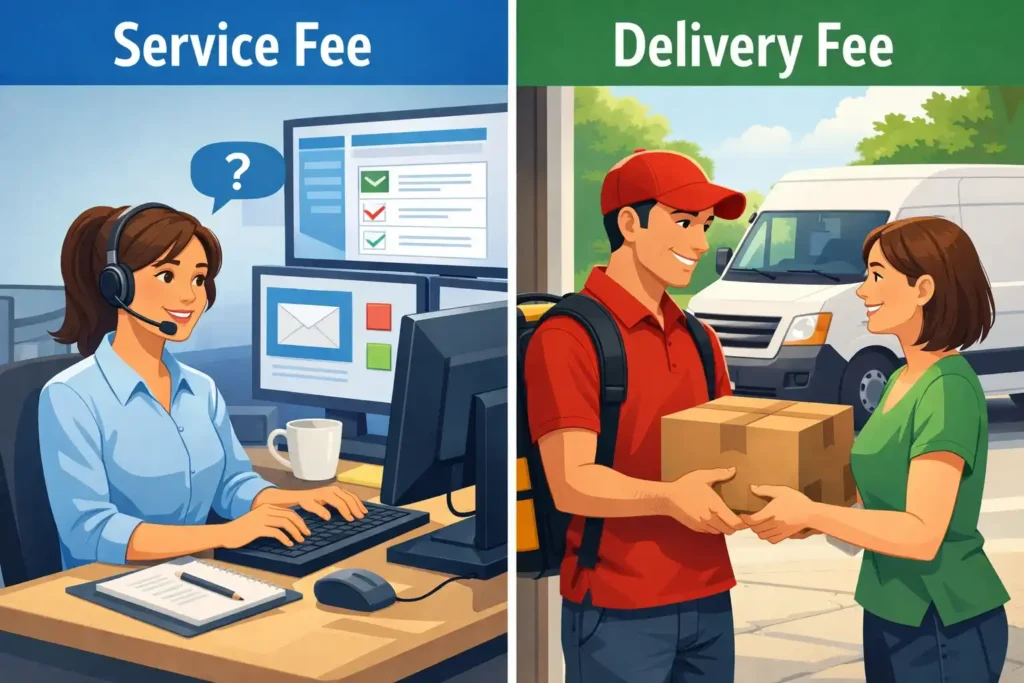
You book a courier pickup, get your invoice, and see two separate charges you weren’t expecting: a service fee and a delivery fee. Are they the same thing billed twice? Is one of them padding the price? The Difference Between Service Fee and Delivery Fee actually comes down to what each charge is paying for. One covers the work behind the scenes that gets your shipment booked, scheduled, and tracked. The other covers the physical job of getting it from point A to point B. At Bearcat Express, we get asked about this almost every week, usually right after someone opens an invoice and starts counting line items. This guide breaks both fees down in plain terms, using real examples from how courier pricing actually works, not just textbook definitions. What Is a Service Fee?   Service Fee Definition Explained A simple service fee definition looks like this: it’s a fee paid for a service, not for the movement of a package itself. When you book a courier run, someone has to receive your request, confirm pickup details, assign a driver, and keep the shipment tracked from start to finish. That coordination work is what the service fee pays for. It’s the same reason a bank charges a small fee for processing a wire transfer separately from the amount being sent. The transfer and the processing are two different jobs, so they get billed as two different things. So if someone asks what is the service fee in the context of a courier order, the short answer is that it’s a fee paid for a service the company performs to make the delivery happen smoothly, not the delivery itself. Why Courier Companies Charge It Courier companies charge a service fee because dispatch and admin work costs money whether or not a truck ever leaves the lot. Someone is answering the phone, confirming addresses, checking special handling requests, and making sure the right driver with the right vehicle gets assigned. For same-day or rush orders, this work gets more intense. A dispatcher might need to re-route an existing driver, call ahead to confirm a receiving dock is open, or flag a fragile item so it gets loaded correctly. None of that shows up as miles on an odometer, but it’s real labor that keeps a delivery on schedule. That’s the practical reason a service fee definition always centers on coordination, not transportation. What Is a Delivery Fee? Delivery Fee Definition Explained If a service fee pays for the planning, a delivery fee pays for the execution. So what is a delivery fee, exactly? It’s the charge tied directly to the physical act of getting your package from pickup to drop-off. This covers driver time, vehicle wear, fuel, and the actual distance traveled. Where a service fee stays roughly steady no matter what you’re shipping, a delivery fee moves depending on the specifics of the run. How Delivery Fees Are Calculated Three things drive most delivery fee calculations: distance, vehicle type, and urgency. A courier run across town costs less than one that crosses three counties, simply because of drive time and fuel. Vehicle type matters too. A small parcel that fits in a sedan costs less to move than a large item requiring a cargo van or a two-person lift. Urgency changes the math again. A scheduled next-day pickup can be planned around existing routes, but a same-day rush request often means pulling a driver off another job or dispatching a dedicated run, which raises the delivery fee accordingly. Why Companies Split the Fee Instead of Charging One Flat Price It might seem simpler to just charge one flat number and call it a day. Here’s why that doesn’t actually work well for either the courier or the customer. A flat rate has to assume an average cost across every possible scenario, which means light, local, simple orders end up subsidizing heavy, long-distance, complicated ones. Splitting the charge into service and delivery keeps pricing honest to what each specific order actually requires. At Bearcat Express, our dispatch team builds quotes this way on purpose. When a call comes in, the coordination side gets priced based on how much handling the order needs, while the transport side gets priced based on distance, vehicle, and timing. That separation is what lets us quote a short local drop differently from a same-day cross-city rush, instead of forcing every customer onto one generic number that doesn’t fit their actual shipment. What the Service Fee Covers Behind the Scenes Behind a service fee, you’re paying for order intake, driver assignment, real-time tracking updates, and the customer support that steps in if something needs to change mid-route. If a receiving location is closed when a driver arrives, someone on the service and delivery coordination side has to make a quick call on rescheduling or rerouting. That kind of problem-solving is part of what the fee supports, even though it never appears as a visible task on your invoice. What You’re Actually Paying for in the Delivery Fee The delivery fee is more straightforward to picture. You’re paying a driver for their time behind the wheel, fuel for the trip, and the wear that comes from regular vehicle use. For larger or fragile shipments, it can also include the extra handling required to load and unload safely. This is why two deliveries of similar distance can carry different delivery fees. One might be a lightweight envelope, and the other a piece of equipment needing careful handling and a bigger vehicle. How Separate Pricing Builds Customer Trust When a business ships regularly, unclear pricing becomes a real problem over time. Splitting charges into a service fee and a delivery fee gives shippers a clear picture of what they’re paying for and why a price changes from one order to the next. A repeat customer can look at their invoice and understand exactly which part of the cost is driven by distance and vehicle needs, and which part covers

What Does an Auto Parts Delivery Driver Do
Delivery

What Does an Auto Parts Delivery Driver Do?

A repair shop can’t complete a job if a critical part arrives late, and dealerships rely on a steady flow of components to meet customer expectations. This highlights the importance of What Does an Auto Parts Delivery Driver Do. These drivers ensure vehicles stay on the road and local automotive businesses operate efficiently. Their role includes picking up and delivering parts from warehouses, suppliers, or retail locations to repair shops, dealerships, and service centers. Companies like Bearcat Express prioritize reliability over speed, understanding how time-sensitive deliveries impact operations. Knowing what does a delivery driver do clarifies this vital support system. What Are the Duties of an Auto Parts Delivery Driver?   An auto parts delivery driver is responsible for more than simply transporting items from one place to another. The role requires accuracy, time management, and knowledge of delivery routes and automotive workflows. Common duties include: Picking up automotive parts from suppliers, distribution centers, or big box stores Verifying delivery parts against invoices and manifests Transporting parts safely to auto repair shops and dealerships Collecting signatures or electronic proof of delivery Communicating delays or issues with dispatch teams Maintaining delivery vehicles in clean and road-ready condition An experienced automotive parts delivery driver understands that a single late delivery can delay multiple repairs, impacting customer trust and revenue. Main Duty of Auto Parts Delivery Driver The main duty of an auto parts delivery driver is to ensure the right part reaches the right location at the right time. Accuracy is critical. Delivering the wrong delivery part can result in wasted labor hours, return trips, and customer dissatisfaction. Drivers must also handle fragile or high-value automotive components carefully, such as: Brake assemblies Electrical components Engine sensors Custom-ordered parts This responsibility separates a professional automotive parts driver from a general courier. Types of Auto Parts Driver Not all auto parts delivery drivers perform the same type of work. The role varies based on business needs, delivery urgency, and service area. Common types include: Local route drivers handling scheduled deliveries to repair shops On-demand drivers fulfilling urgent or same-day part requests Warehouse-to-store drivers supplying retail auto parts outlets Big box pickup drivers managing orders from national retailers Some courier companies also specialize in services like Big Box Store Pick Up Augusta, GA, supporting local shops that source parts from large retail chains. Each type of delivery parts driver must adapt to different time pressures and customer expectations. How Auto Parts Delivery Supports Local Auto Businesses Auto parts delivery is a critical support system for local automotive businesses. Without reliable drivers, shops would need to pause repairs or keep costly inventory on hand. Auto parts delivery supports local businesses by: Reducing vehicle downtime for customers Allowing repair shops to operate with lean inventory Supporting same-day and emergency repairs Improving service turnaround times A dependable automotive parts delivery driver helps shops focus on repairs instead of logistics. Companies like Bearcat Express often work closely with auto businesses to align delivery schedules with repair workflows. This partnership model strengthens local economies and improves customer satisfaction across the automotive service industry. Who Hires Auto Parts Delivery Drivers? Auto parts delivery drivers are hired by a wide range of organizations, not just courier companies. Common employers include: Auto parts retailers and distributors Independent repair shops Car dealerships Logistics and courier service providers Fleet maintenance companies Some drivers work directly for parts suppliers, while others work for specialized courier companies that handle delivery parts across multiple industries. Regardless of the employer, understanding what does an auto parts delivery driver do remains essential for maintaining consistent service quality. What Are the Pros and Cons of Being an Auto Part Delivery Driver? Like any logistics role, being an auto parts delivery driver has advantages and challenges. Pros Predictable local routes Consistent demand and job stability Opportunity to work independently Direct impact on business operations Cons Time-sensitive delivery pressure Physical demands, including lifting parts Traffic and weather challenges Responsibility for accurate deliveries An experienced automotive parts driver learns to manage these challenges through planning, communication, and route optimization. Auto Parts Driver Skills and Personality Traits Success in this role depends on both technical skills and personal qualities. A delivery driver in the automotive sector must balance speed with precision. Key skills include: Strong time management Basic vehicle maintenance knowledge Navigation and route planning Customer communication Attention to detail Key Personality Traits Effective auto parts delivery drivers often share these traits: Reliability and punctuality Problem-solving mindset Calm under pressure Professional attitude Accountability These qualities directly influence how well a delivery parts driver performs, especially during urgent or high-volume delivery days. Conclusion Understanding What Does an Auto Parts Delivery Driver Do reveals how essential this role is to the automotive ecosystem. From ensuring accurate deliveries to supporting local repair shops, auto parts delivery drivers keep operations moving without interruption. If your business relies on fast and dependable part movement or you need a trusted local courier, working with a professional service like Bearcat Express can make a measurable difference. Contact us today to discover how reliable auto parts delivery can enhance your operations and minimize downtime. FAQs What does an auto parts delivery driver do daily? An auto parts delivery driver picks up and delivers automotive components to repair shops, dealerships, and service centers. Daily tasks include verifying delivery parts, following assigned routes, and confirming successful deliveries. Is an automotive parts delivery driver different from a regular delivery driver? Yes, an automotive parts delivery driver handles time-sensitive and specialized parts. The role requires greater accuracy and understanding of automotive workflows compared to general delivery work. Who benefits most from auto parts delivery services? Auto repair shops, dealerships, and fleet operators benefit the most. Reliable delivery parts service helps them complete repairs faster and serve customers more efficiently. What skills are important for a delivery parts driver? Time management, attention to detail, safe driving habits, and clear communication are essential. These skills help ensure the right parts arrive on time. Why is local auto parts

What is a Delivery Service Provider
Delivery

What is a Delivery Service Provider?

Ever stared at a tracking page wondering what “tendered to delivery service provider” actually means? You’re not alone; it’s one of the most-searched, least-explained phrases in shipping. Put simply: a delivery service provider is any company or courier that physically carries your package from one point to the next, whether it’s a national name, a regional network, or a local same-day team like ours. We are that provider for businesses across Georgia every single day. In this guide, we’ll unpack what the term really means, what the job actually involves behind the scenes, and how a local provider like Bearcat Express steps in when a national carrier hands off the final leg. What Does Delivery Service Provider Mean?   A delivery service provider is any business responsible for the physical transport of a package, document, or shipment between two points. The service provider meaning is broader than most people assume. It is not limited to national shipping brands. It includes local couriers, on-demand delivery services, freight carriers, and regional networks that handle the final leg of a shipment’s journey. When a tracking update lists a delivery service provider by name, it is telling you which specific company currently has physical custody of the package. This distinction matters because a single shipment can pass through more than one provider before it reaches its destination, and each handoff is usually logged as its own tracking event. What Does It Mean When a Package Is Tendered to a Delivery Service Provider? This is one of the most searched phrases related to this topic, and for good reason, since it rarely gets explained clearly. When a package is tendered to a delivery service provider, it means custody of the shipment has officially transferred from one party to another, usually from a national carrier’s regional hub to a local courier who will complete the final delivery. Here is what that looks like in practice. A national carrier might handle the long-distance transport of a package into a regional facility, then tender it to a local delivery service provider like Bearcat Express to complete the last few miles into a specific neighborhood or business district. The tendered-to delivery service provider means status simply confirms that handoff happened successfully. It does not mean the package is lost or delayed. It means responsibility has shifted to the provider best positioned to complete that specific leg of the trip. Types of Delivery Services Delivery service providers generally fall into a few categories, and knowing the difference helps explain why tracking pages sometimes list more than one company name for a single shipment. National and Regional Carriers These providers handle high-volume, long-distance transport across states or the country. They are built for scale, not speed, and typically work on multi-day delivery windows rather than same-day turnaround. Local Courier Services Local couriers handle short-distance, time-sensitive runs, often same day, within a specific city or region. This is where speed and direct communication matter most, since the entire run usually happens within a few hours rather than days. On-Demand Delivery Providers These providers handle single pickup and drop-off requests, usually booked directly by a business or individual rather than routed through a larger network. They are built for one-off, immediate needs rather than recurring or scheduled shipments. Specialized Delivery Services Specialized providers handle categories that require extra care, such as medical courier runs or white glove furniture delivery. These runs often involve specific handling requirements, tighter timing, or added coordination that a standard delivery does not. Each type plays a different role, and many shipments actually pass through more than one type before reaching the final recipient. Tasks of Delivery Service Providers The day-to-day work of a delivery service provider goes well beyond simply driving a package from point A to point B. A recent example from our own dispatch floor illustrates this well. A local medical office needed lab samples picked up from three separate clinics and delivered to a testing facility before a strict afternoon cutoff. This is not a single pickup and drop-off. It requires route sequencing, confirmed pickup windows at each stop, and a driver who understands the handling requirements for medical specimens. The dispatcher planned the route in the order that minimized total transit time, confirmed each clinic’s pickup window by phone before the driver left, and tracked the run in real time so the testing facility knew exactly when to expect the final drop-off. That kind of coordination, not just driving, is what separates a reliable delivery service provider from a basic point-to-point run. Tasks typically include route planning, pickup confirmation, real-time tracking updates, proof of delivery collection, and communication with both the sender and recipient when a delivery window shifts. How Local Delivery Service Providers Support Small and Medium Businesses Small and medium businesses often depend on a local delivery service provider for the kind of flexibility that larger national carriers cannot offer. A same-day courier can pick up a forgotten contract from a law office and deliver it across town within the hour, something a scheduled national shipment simply is not built for. At Bearcat Express, we regularly work with local businesses that need this kind of responsiveness, whether that is a retail store needing a same-day restock from a supplier or a medical office needing equipment moved on short notice. A local delivery service provider fills the gap that exists between placing an order and needing it there today, not next week. This also matters for businesses managing customer expectations. A business that can promise a same-day delivery service provider option to its own customers has a real competitive advantage over one relying entirely on standard shipping timelines. Benefits of Delivery Service Providers Working with the right delivery service provider offers a few concrete advantages beyond simple transport. Faster turnaround is the most obvious one, particularly for same-day or time-sensitive shipments where a delay has real business consequences. Direct communication is another. A local provider is easier to reach for a status

how much does it cost to ship shoes
Delivery

How Much Does It Cost to Ship Shoes? (2026 Guide)

You weigh the box, pick a service, and the price on screen feels wrong for one pair of sneakers. That is why people keep asking how much does it cost to ship shoes before they list a pair, send a gift, or restock a shelf. For most single pairs within the United States, the answer lands between $8 and $25, depending on packed weight, distance, speed, and how much air is in the box.  Bearcat Express runs same-day courier routes across Georgia and Alabama. This guide covers parcel pricing, surprise fees, and when a local driver beats a shipping label. Quick Answer: How Much Does It Cost to Ship Shoes? A pair of shoes in a standard retail box weighs about 2 to 3 pounds once packed. Sent by ground service, that parcel usually costs $8 to $19, and faster weight-based services push it toward $25. If you are wondering how much is it to ship a pair of shoes without the box, a padded mailer under one pound can cost as little as $5 to $7. Service type Typical cost for a 3 lb shoebox Postal ground service $8.50 to $14 Postal faster weight-based service $10 to $16 National ground carrier $11 to $19 Shoes only, padded mailer under 1 lb $5 to $7 Treat these as planning ranges. A live quote with your exact zip codes and a measured box will always beat a table. Average Cost to Ship Shoes in 2026: By Service Level and Number of Pairs Price climbs with weight, but not in a straight line. The first pair carries the full handling cost of the label, while the second and third add mostly weight. That is why three pairs in one carton usually cost far less than three separate parcels. Anyone asking how much does it cost to ship a pair of shoes should also ask how many pairs are travelling together, because the per-pair figure can fall by a third or more in a shared box. Shipment 1 pair 2 to 3 pairs 4 or more pairs Domestic ground $8 to $14 $14 to $24 $24 to $45 Domestic express $20 to $38 $32 to $55 $50 to $90 International economy $18 to $42 $35 to $65 $60 to $110 How 2026 Rate Increases and Surcharges Change the Math Carriers revise their published rates every year, and the size and handling rules beside those rates shift too. Shoe boxes are light but bulky, so size-based fees hit them harder than the base rate does. From late October into early January, many carriers also add a peak-season charge that often adds a couple of dollars to each parcel. Before pricing a large restock, read your carrier’s current rate and surcharge notice instead of trusting last year’s numbers. What Drives the Price: Weight, DIM Weight, Zones, and Speed Carriers bill whichever is higher: scale weight or dimensional weight. Dimensional weight is length times width times height, divided by a divisor that is commonly 139 for domestic parcels. Take a shoebox packed into a 13 by 9 by 5 inch carton. That is 585 cubic inches, which divides out to about 4.2 pounds even if the shoes weigh two. Trim the carton to 12 by 8 by 4.5 inches, and the figure falls to roughly 3.1 pounds. About an inch of space is often the difference between two price brackets. Distance works through zones. Zones 1 and 2 cover roughly the first 150 miles, and the numbers climb until you reach cross-country runs beyond 1,400 miles. Speed is the third lever, and expedited service commonly costs 60 to 100 percent more than ground for the same box. Weight, distance, and speed multiply against each other instead of simply adding up, which is why working out how much to ship shoes gives such different answers for the same pair. Hidden Fees Most Shippers Miss The label price is only the starting point. Five extras tend to show up later: Oversize and additional handling: A box that crosses a carrier’s size threshold can trigger an extra fee even when it weighs very little. Boot boxes are the usual offenders, so measure before you print. Peak surcharges: The seasonal charge described above applies per parcel, which hurts most on multi-order days. Customs and HS codes: International parcels need an accurate description, material, declared value and a tariff (HS) code for footwear. Duties follow value and material. Shoes made with protected animal materials can need permits or be refused at the border. Insurance: Basic liability coverage is commonly around $100. Extra coverage typically costs about $1 to $3 per $100 of declared value. Damage and reships: A pair that arrives crushed and has to be sent again doubles the label cost before refunds or lost goodwill are counted. So how much does it cost to ship shoes once all of this is added up? Often noticeably more than the number on the first screen. Shoe Shipping Cost by Shoe Type Weight is the quiet driver here, and it follows the shoe category closely. Category Packed weight Domestic ground Best method Sandals and flip-flops 0.5 to 1 lb $5 to $9 Padded mailer Sneakers 1.5 to 2.2 lbs $9 to $15 Retail box inside a poly mailer Dress shoes and loafers 2 to 2.5 lbs $10 to $16 Snug carton Work and winter boots 3.5 to 6 lbs $14 to $24 Carton, then compare flat-rate Designer pairs 2 to 3 lbs $11 to $19 plus insurance Double-box with signature These are counter-rate estimates. Business accounts and shipping platforms often pay less. When Shipping Eats Your Resale Profit Shipping is a fixed cost, so it bites hardest on cheap pairs. Using a $10 label as the example: Sale price Share of the sale spent on the label $30 33% $60 17% $120 8% $250 4% Platform fees come on top of that. If a pair sells for $30, the label alone can swallow a third of the money, so either price

How To Start A Delivery Business
Delivery

How To Start a Delivery Business (Step-by-Step Guide)

A dental office needs lab impressions across town by noon, and its usual driver is stuck on another run. Whoever shows up on time can earn that client for years. If you are working out how to start a delivery business, choose one niche, register a legal entity, insure the vehicle for paid work, set up simple dispatch tools, and sign a few local clients first.  Bearcat Express runs same-day routes across Georgia and Alabama, so this guide comes from the road. Wondering how do i start my own delivery service, or how to start a courier business? Keep reading. Quick Answer: How to Start a Delivery Business Here is the process in the order you would actually do it. Choose a lane. Local parcels and documents, retail pickups, recurring multi-stop routes, or specialized runs such as lab samples and legal filings. Specialized work usually pays more but expects more from you. Register the business. Pick an LLC, corporation, or sole proprietorship, get an EIN from the IRS, and check which local, state, and federal permits apply to commercial driving where you live. Insure it properly. Commercial auto coverage comes first, because a personal policy often refuses claims from paid deliveries. Add cargo coverage for client goods, general liability, and workers’ compensation once you hire. Set up your tools. A dependable vehicle, routing and dispatch software with GPS and proof of delivery, a separate business bank account, and bookkeeping that logs fuel, mileage, and repairs. Find your first clients. Approach law offices, medical practices, real estate agencies, and neighborhood shops with a one-week trial or a recurring weekly route, so they can test you at low risk. Price and review. Charge enough to cover every cost and pay yourself, then check your numbers every month. Is a Delivery Business Actually Right for You? First, be honest about the daily grind. Dispatching, rescheduling, answering calls, and fixing a missed pickup while you sit outside another stop is the real job. A good test is to ride along with a working driver for a day, or run a few paid errands yourself. If sudden changes energize you, the work will suit you. If they drain you, better to learn that now. Anyone drawn to how to start your own courier business mainly because they like driving should know that driving is only part of the job. The rest is communication, timing, and paperwork. Delivery Business Models Compared If you are studying how to start a pickup and delivery service, notice how much the model changes everything that follows, from insurance to client type. Model Typical client Setup effort Income pattern Local courier Law firms, clinics, retailers Low to moderate Steady, often contract-based Same-day and on-call Businesses with urgent drop-offs Moderate Demand-driven, premium rates Retail pickup and delivery Florists, boutiques, furniture shops Low Follows the shops’ busy seasons Food delivery Restaurants, households Low Thin margins, volume dependent Specialized (medical, legal) Labs, pharmacies, law offices High Recurring, higher margin Real Startup Costs: What Regional Operators Actually Spend Published startup estimates for delivery companies run from about a thousand dollars to well over a hundred thousand, which is not very helpful when you are holding a calculator. The gap exists because those estimates describe different businesses. Business type Commonly published startup range Small courier, owner drives one vehicle $1,000 to $5,000 Medical courier $15,000 to $35,000 Food delivery $10,000 to $50,000 Cargo van operation with several vehicles $49,000 to $104,000 Last-mile operation with a fleet $100,000 to $250,000 These are published industry estimates, not quotes. Four things stretch the ranges: whether you own, finance, or run several vehicles; the niche, since medical and legal work add training, equipment, and stricter insurance; insurance itself, which shifts with your state, driving record, and cargo value; and technology, which can be a free map app or a full dispatch platform. Put your own figures into a delivery service business plan that lists one-time costs, monthly costs, and the number of paid deliveries needed to cover them. If you are learning how to start a delivery business on a limited budget, keep the first version simple: one vehicle, one niche, three target clients. A lender will ask for this plan anyway, and it shows you quickly whether the idea holds up. Which Model Makes the Most Money? The One-Vehicle Break-Even Table The highest rate per delivery does not automatically win. What matters is how many paid stops fit into a day without driving empty. Contract courier work and specialized runs often win on predictability. Same-day delivery, such as our Same Day Delivery in Augusta, GA service, earns a premium for urgency, but only when stops sit close together. A delivery service for small business clients, such as clinics and law offices, rewards repeat routes more than one-time rush jobs. Food delivery can bring volume, but fees and fuel squeeze the margin. Here is a simple way to test any model. The numbers are illustrative only, so swap in your own quotes. Monthly item Illustrative amount Vehicle payment $500 Commercial auto and liability insurance $450 Dispatch and routing software, phone $100 Maintenance reserve $150 Registration, bookkeeping, small extras $100 Fixed total $1,300 Owner pay target $2,500 Total to cover $3,800 Say each delivery brings in $16 and costs about $5 in fuel and wear, leaving $11 of margin. To cover $1,300 of fixed costs, you need about 119 deliveries a month, which is five or six a day across 22 working days. To also pay yourself $2,500, you need about 346 deliveries, or roughly 16 a day. Commercial insurance can cost more than the placeholder above, so get real quotes first. If the result looks high, the fix is rarely to work harder. Raise the rate, tighten the route, or pick a model that pays more per stop. Licensing, Insurance & Compliance Checklist Rules vary by state and county, so treat this as a starting list and confirm details with your state business office or the SBA licensing guidance.

what is contactless delivery
Delivery

What Is Contactless Delivery? A Complete Guide

You are in a meeting, the doorbell camera pings, and the courier is already walking back to the van. Was the delivery missed or finished? For a growing share of orders, it is finished, and that is the whole idea. So, what is contactless delivery? It is a way of completing a drop where the courier leaves the order in an agreed spot, such as a porch, lobby shelf, or front desk, and proves it with a photo and an instant alert instead of a handoff.  Local couriers like Bearcat Express use it to keep routes moving while customers choose when and how they receive things. Quick Answer: Contactless Delivery in 50 Words Contactless delivery means the courier finishes a drop without meeting the recipient. The customer orders and pays online, chooses a no-contact option, and adds drop instructions. The driver leaves the parcel in the agreed spot, takes a photo, and sends an alert, so everyone has proof without a handoff. What Is Contactless Delivery? The meaning of contactless delivery is simple: the order reaches the customer, but the two people never need to be at the door at the same moment. Companies use different labels. No-contact, contact-free, and no-touch delivery all describe the same idea, which also answers what no-contact delivery means for most shoppers. Picture a law office waiting on a signed contract. Instead of waiting for a receptionist to come out, the courier leaves the envelope at the front desk, photographs it beside the suite sign, and the office gets a time-stamped alert within seconds. Types of Contactless Delivery What is no-contact delivery in practice? It is wider than leaving a box on the doormat, and the right format depends on the item and the building. Type Where the package goes Best for Proof needed Doorstep drop Porch, mat, or shelf by the door Standard parcels and meals Photo showing the item at the door Lobby or reception Front desk or mailroom shelf Offices, apartments, documents Photo plus desk or suite name Locker or pickup point Secure locker opened by a code Higher-value items Code scan or locker confirmation Contactless pickup Customer collects at the curb or counter Retail and bulk orders Order number check Secure box or gated drop Lockbox, garage, or side gate Homes with repeat deliveries Photo plus location tag Contactless pickup flips the direction. The customer comes to the store, and staff places the order at the curb or counter without a handoff. How Does Contactless Delivery Work? Order and pay online. The customer pays by card or mobile wallet and selects a no-contact option. Write the instructions. Say where the parcel goes, which entrance to use, and how to get in. “Side door, blue bin on the porch, gate code sent by text” beats “somewhere safe.” Dispatch. The request is flagged so the driver sees it before arriving. Drop. The driver places the parcel on the ground, a chair, or a shelf in the agreed spot, out of the weather when possible. Confirm. A photo, timestamp, and GPS point are saved, and the customer gets a text, email, or app alert. Vague notes are where drops tend to go wrong, so the instruction step deserves the most care. Contactless Proof of Delivery: What Counts as Valid Proof Contactless proof of delivery is the record showing the drop happened where it should have. A useful record combines four things: a photo with context, a timestamp, a GPS location, and the notification sent to the recipient. Context matters most. A parcel on bare concrete proves little, while the same parcel beside a unit number proves a lot. Some items need more, such as an electronic signature or an access code, and a good contactless delivery solution can collect those without face-to-face contact. Why Contactless Delivery Is Still in High Demand Anyone asking what is contactless delivery today is usually asking why it stayed popular. Convenience is the first reason: people can receive orders during meetings, school runs, or night shifts without planning around a knock. Hygiene and personal space still matter to many customers too. The operational reason is just as strong. A driver who does not wait for a door to open completes more stops, and fewer failed attempts mean fewer repeat trips. For same-day work, saved minutes add up, which is why a local Same Day Delivery Service Augusta, GA provider treats unattended drops as a core part of the route rather than an exception. Drop or Hold? The Green, Amber, Red Rule Behind Every Contactless Drop Every contactless drop is a small decision. A practical way to make it consistently is to sort the stop into green, amber, or red before the parcel leaves the van. Exact policies vary by company, but the logic holds. Green: Drop and Document The note is clear, the spot is reachable, the weather is fine, and the item is low risk. Drop it, photograph it with a landmark in the frame, and send the alert. A box of printer paper beside a marked side door is a typical green stop. Amber: Drop With Extra Safeguards Something is slightly off: the spot is exposed, rain is coming, the item is valuable, or the note is vague. Choose the most sheltered position, message the recipient, and record what was changed and why. Red: Hold, Call, or Return Do not leave it. Age-restricted or signature-required items, temperature-sensitive goods, a locked building with no access, or an unsecured dog at the gate all belong here. Hold the parcel, call, reschedule, or return it, and tell the sender the reason. Light Situation Action Record kept Green Clear note, safe spot, low-risk item Drop Photo, time, GPS, alert Amber Exposed spot, weather, higher value, vague note Drop with safeguards or message first Photo plus note on what changed Red Restricted item, no access, no safe spot Hold, call, or return Attempt log and reason sent to sender Which Industries Benefit Most From Contactless Delivery? Industry Why it fits Typical

what is last mile delivery
Delivery, Courier

From Dispatch to Doorstep: What Is Last Mile Delivery?

A parcel can cross several states in two days and still leave a customer annoyed because of what happens in the final ten minutes. A missed handoff, a vague tracking message, or a driver stuck behind a locked gate can undo all the work that came before. If you have ever asked what is last mile delivery and why logistics teams obsess over it, this guide covers how it works, why it costs so much, and how to read the status updates on your tracking page.  Bearcat Express runs local same-day routes, so the focus here is on how this final stretch behaves in practice. Quick Answer: Last-mile delivery is the closing stretch of a shipment’s trip, when a parcel leaves a nearby hub or store and gets to the person who ordered it. It covers the shortest distance but usually the highest cost, since it means many stops, small loads, and high expectations. What Is Last Mile Delivery? Most shipments move through three stages, and the last mile is the only one the customer ever sees. Stage Where it happens Typical vehicle Main goal First mile Seller or warehouse to the first carrier facility Truck or van Get goods into the network Middle mile Between hubs and regional centers Linehaul truck, rail, air Move volume cheaply Last mile Local hub to the recipient Van, car, bike, on foot Deliver accurately and on time So what is last mile delivery in practical terms? It is short in distance but dense in work: many separate addresses, each with its own access rules, delivery window, and recipient. A late truck between hubs can be absorbed by a buffer. A late driver on a local route cannot, which is why same-day and scheduled services depend almost entirely on this stage. Why the Last Mile Costs So Much Commonly cited industry estimates place the last mile anywhere from roughly a quarter or a third of total delivery cost up to about half, depending on route density and service level. Treat that as a range, not a fixed rule. Cost driver Why it hurts Labor Driver time is spent per stop, not per mile Fuel and vehicle wear Stop-and-go driving burns more than highway miles Low drop density Few parcels per stop raises cost per parcel Failed attempts A redelivery repeats the trip Narrow windows Tight promises reduce routing flexibility Failed attempts deserve special attention. When nobody answers, an address is incomplete, or a building blocks access, the driver either returns with the parcel or schedules a second trip. The business pays twice, and the customer waits longer. Repeat that often enough, and the damage goes beyond cost: customers stop reordering, and your brand takes the blame for a problem that happened on the doorstep. Key Steps in the Last Mile Delivery Process Hub check-in. The parcel arrives at a nearby facility or store and is scanned into the local system. Sorting and route assignment. Parcels are grouped by area and assigned to a driver, with stops sequenced by delivery window, traffic, and vehicle capacity. Loading in reverse order. The first stop is loaded last, so the driver is not digging through the vehicle at every door. Out for delivery. The driver starts the route, and the customer usually receives live tracking or automated alerts. Handoff and proof. The parcel is handed over, left in a safe spot, or placed in a locker, and a photo, signature, or scan confirms it. Inside a 10-Stop Route: Where the Minutes Actually Go A route is not one long drive. It is ten small jobs stacked end to end, and the minutes between them decide whether a schedule holds. The Time Budget Per Stop The table below is an illustrative planning example for a residential route, not measured data. Real numbers shift with neighborhood, parcel size, and building type. Task at each stop Example time Driving to the next address 4 to 8 minutes Parking and walking to the door 1 to 3 minutes Handoff or doorstep drop 1 to 2 minutes Proof capture (photo, signature, scan) Under 1 minute Exception (gate code, no answer) 3 to 10 minutes, when it happens Even with no problems, ten stops can fill about two hours. Driving looks like the main cost, but the walk to the door, the handoff, and the proof capture add up quietly. Three minutes lost at one gated entrance is three minutes borrowed from every stop after it. What Breaks a Route Most delays come from a short list of repeat offenders: Locked gates, or apartment buildings with no working call box Missing unit numbers, or addresses that map to the wrong entrance Recipients asking to change the window after the route is set Oversized items that need two people or a ramp A traffic incident on the one road that connects two clusters of stops When one of these hits early, a dispatcher usually has to resequence the remaining stops so the tightest windows are still met. Flexible stops move back, and the route is rebuilt in real time. Last Mile Tracking Statuses Decoded Carriers word their updates differently, but a few phrases come up constantly. People often search for last mile enroute meaning when a status changes and then nothing moves for hours. Status What it usually means What to do Last mile enroute The parcel is heading to or assigned within the local delivery area Watch for a delivery window Last mile departed The parcel has left the local hub on a delivery vehicle Make sure someone can receive it Out for delivery The driver is working the route Check access notes and gate codes Delivery attempted The driver tried but could not complete the handoff Respond to the notice and reschedule The short version of what does last mile departed mean: the parcel has left the local hub and is now with a driver. The last mile departed meaning is good news, but it is not a promise for the next

what's the difference between shipping and delivery
Delivery

What’s the Difference Between Shipping and Delivery?

Your phone buzzes: your order has shipped. You plan your day around it, and then nothing arrives for days. Sound familiar? You have run into the gap behind a common question: what’s the difference between shipping and delivery? The two words sound alike, but they describe different stretches of the same journey, and mixing them up often causes missed packages and avoidable support calls.  At Bearcat Express, a same-day courier serving Georgia, Alabama, and nearby regions, our work sits at the delivery end of that journey. This guide explains the split in plain language, with tables for confusing tracking pages.  Quick Answer Shipping is the stage where an order is packed, labeled, and handed to a carrier so it can travel through a transport network. Delivery is the final handover of that order to the recipient at their address. Put simply, shipping gets the package moving, and delivery is where the journey ends. That is the short version of the difference between shipping and delivery. The rest of this guide shows where the line actually sits on a real tracking page. Shipping vs Delivery at a Glance For a quick side-by-side view of shipping vs delivery, this table covers the points people ask about most. Shipping Delivery Meaning Getting the order out of the seller’s hands and moving through a carrier network Handing the order to the recipient at the destination Starts when The seller packs the order, and the carrier takes it The package reaches the final local leg of the route Ends when The package arrives at the last local facility or driver The recipient or their address receives it Who handles it Seller, warehouse team, carrier, sorting hubs Local driver or courier Date you see Ship date Delivery date or delivery window Tracking status Shipped, in transit Out for delivery, delivered Who to contact The seller first, then the carrier The carrier or local courier What Shipping Actually Covers If you have ever typed “what do shipping mean” into a search bar, you are not alone, because the word carries two meanings. The first is the process. Shipping includes picking the item from a shelf, packing it, printing a label, and handing it to a carrier. After that, the package keeps being shipped as it moves through sorting hubs and long-distance transport, which is why an item can be in the shipping stage for several days while still being hundreds of miles from you. The second meaning shows up at checkout. A “shipping charge” is simply the fee for moving the order, and “free shipping” means the seller is absorbing that fee. It says nothing about speed. A free option can still be the slowest option, so always read the estimated arrival date, not just the price label. What Delivery Actually Covers Delivery is the last-mile step. A local driver takes the package from the final facility and brings it to the address on the label. The main outputs of this stage are a delivery window, the handover itself, and proof of delivery, which may be a signature, a photo, or a scan. This is also where the difference between ship and delivery becomes practical. Shipping is largely invisible to you, since it happens in warehouses and on trucks. Delivery is the part you can see, so it is the part people judge a service by. A package can travel flawlessly for three days and still feel like a failure if the last mile goes wrong. One Order, Three Clocks Every order runs on three separate clocks, and most confusion comes from treating them as one. Here is a hypothetical example, not real carrier data, to show how they fit together. Clock What it measures Example timeline Processing clock Order placed until the carrier takes the package Monday 10 a.m. to Tuesday 2 p.m. Shipping (transit) clock Carrier pickup until the package reaches the local delivery stage Tuesday 2 p.m. to Thursday 7 a.m. Delivery clock Loaded for delivery until the handover Thursday 10 a.m. to 2 p.m. window, handed over at 12:40 p.m. Notice that the “shipped” notification arrives at the end of the first clock, not the start of the order. A seller who is slow to pack can still ship, and the transit clock might not be slow at all. The reverse also happens: a fast processing clock followed by a congested transit leg. Keeping the three clocks separate makes it much easier to see where time is really being spent. Shipped vs Out for Delivery vs Delivered: What Each Status Means When you are staring at a tracking page wondering whether it is shipped or delivered, the wording matters. Statuses vary by seller and carrier, but this decoder fits most of them. Status What it usually means Is it at your door? Label created The seller printed a label, but the carrier may not have the package yet No Shipped The carrier has accepted the package, or the seller marked it as sent No In transit The package is moving between facilities No Out for delivery The package is loaded on the local vehicle for today’s route Not yet, but close Delivered The handover or drop-off has been recorded Yes, or it should be This is the heart of the difference between shipped and delivered. Shipped tells you the order has left the seller’s control. Delivered tells you it has reached yours. One caution: some sellers mark an order “shipped” when the label is printed, before the carrier has scanned anything, so a shipped status with no movement for a day is not unusual. Date, Address, and Fee: The Three Most Confused Pairs Some of the most common mix-ups sit inside shipping vs delivery pairs that look identical on a checkout page. Pair Shipping side Delivery side Date The ship date is when the package leaves the seller for the carrier The delivery date is when it should arrive, or did arrive Address The shipping address is the place the seller sends

what is same day delivery
Delivery

What is Same Day Delivery? Faster Shipping & Big Benefits in 2025

After COVID-19, online sales have increased globally, especially the number has increased dramatically in America. This dramatic shift is not temporary; it’s here to stay and increase year by year. In online sales, the service that remains most in demand is same-day delivery, and it will be in demand in the future. But, what is same day delivery?  How does same-day delivery work? Why should you choose same-day delivery, and what is its cost? Let’s discover the answer to all these questions with me to understand same-day delivery and its future. What is same day delivery? Before coming to the reasons for its demand, let’s know what does same day delivery mean. It’s a courier and logistics service that picks up or collects your parcel the same day and ensures you receive your parcel the same day. The delivery item can be anything like documents, groceries, big boxes, confidential and legal reports, medicines, organs, and lab tissues, unless it’s illegal.  What makes this service most respected and in demand is its efficient and quick services. No speedy performances means no same day because it’s the fastest option available. All the money is for fast speed and on-time delivery. According to a study, 56 % of Gen-Xers and 64% of millennials purchase online instantly if a same-day delivery option is available.  How same day delivery work? What is same day delivery? It’s checked. Now let’s come to its working process. Same day parcel delivery works very well, and it’s received on the same day. Not only are your customers happy with this service, but your shipping and inventory cost is also lowered. Here, your business gets a chance to have an edge over its competitors. How it works; Confirm your order First of all, you have to book the service. Then you have to pay for the services either online or physically. Then you will receive your tracking number. With which you can track your parcel, where it is when it will be delivered.  The order is picked When you confirm your order, our same-day courier drivers rush immediately to pick up the package and deliver it as soon as possible on the same day.  Delivery With fast, effective, and reliable speed, your parcel is delivered to the final destination.  When you order same-day services, you should keep all aspects in mind. Understand service hours,  the limitations, and offerings.  Same-day service works well in local or regional areas due to location and distance. For example, Bearcat Express is a reliable courier & delivery service in Augusta, GA, and its nearby areas.      What is the difference between same-day delivery and shipping? Same day delivery vs same day shipping, both sound like they are the same. But no, they are not the same; both services are different. Let’s understand the difference: Same-day shipping Same-day shipping means your parcel will be picked up and put in transit on the same day you place the order. But delivery on the same day is not a guarantee. It will be a standard delivery after that, which means it can take 3-7 days to deliver.  Same-day delivery Same-day delivery means you will receive the parcel same day you placed the order. Which means till noon, you will receive the parcel if you place it in the morning. This is fast and more expensive.  Why choose same-day delivery? Here are some key benefits that make this service popular and in demand among customers and businesses.   Happy customer When customer receive their parcel on time, they build trust with the brand and think of it as reliable. When customers are happy, they will order or book a service again and again. This will definitely increase the conversion rates of businesses.  Convenience You pay to save the trip cost. Yes, I am right. You can book this service from the office, home, stadium, church, or anywhere. And receive or send the parcel within a few hours. This accessibility not only saves and manages your time but also excludes the need and cost to go to the store or your required location.    Peace of mind When you can order from your comfort place, you don’t have to wait for days, your time and money are saved, then definitely you’ll be satisfied and stress-free. This is a game-changer for busy people. Who can do their work and simultaneously receive their parcel without going anywhere. Efficiency You forgot your girlfriend’s birthday, were busy with meetings, or dealing with a deadline?  No worries at all, book the service and our courier will send the driver to pick up your gift and deliver it to your girlfriend or any other important person.  This service is beneficial for last-minute events and operations, providing a solution for your emergency needs. How to choose a same-day delivery service Check the following points before booking the service: Pricing: Due to its premium and fast service, it’s expensive as compared to traditional and standard courier services. Ask for a quote and then take the next steps.  Reliability: Reliability is as important as speed of delivery. Check the reputation of the courier company. Do they deliver your parcel safely and especially on time? Check it online from customer reviews and stars. Delivery Area: Make sure the courier company provides the same-day delivery services to your area. Companies can’t cover all the areas of the U.S. Bearcat Express covers delivery services in Augusta, GA, and its nearby regions within 30 miles. So if you are living in Augusta, choose a reliable courier service that knows the area and is well reputative like Bearcat Express. Conclusion Same-day delivery should be reliable, fast, on-time, efficient, and convenient. It not only makes loyal customers but also drives sales for the business. Here we can say time is money. Some parcels can’t be delayed; that’s why Bearcat Express offers same-day delivery in Augusta, GA, and its nearby areas within 24 hours. Faqs Q: Can we send a courier in one day? A: Yes, you can

Scroll to Top