
If you run a delivery business and are wondering how to get medical courier contracts, you are entering one of the most stable niches in the courier industry. Hospitals, labs, and pharmacies need dependable partners who move specimens, records, and pharmaceuticals without delay, and they pay a premium for couriers they can trust.
Bearcat Express has watched this niche grow steadily across Georgia, Alabama, and nearby regions, and the couriers who succeed are rarely the cheapest. This guide breaks down what medical courier contracts involve, what healthcare facilities look for, and how a smaller courier business can realistically win this work.
What Are Medical Courier Contracts?
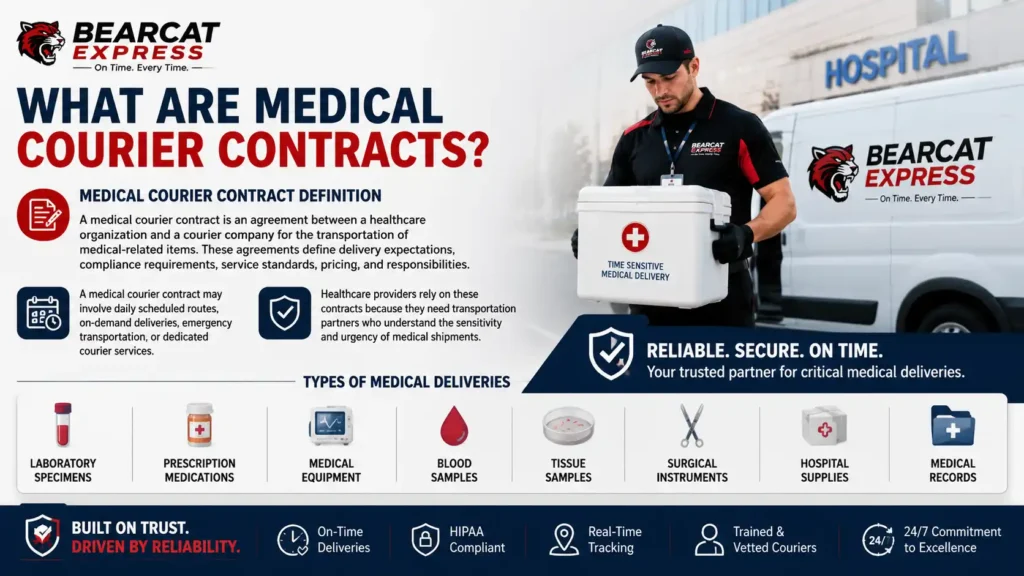
A medical courier contract is a formal agreement between a delivery business and a healthcare organization, such as a hospital, diagnostic lab, pharmacy, or clinic, to handle time-sensitive and often sensitive shipments regularly. Unlike a one-off delivery, a contract medical courier arrangement usually involves set pickup windows, defined service areas, and specific handling requirements written directly into the agreement.
These deliveries can include lab specimens that need to stay within a certain temperature range, pharmaceuticals that require secure handling, patient records, and even medical equipment moving between facilities. Because the contents are often time-sensitive or confidential, healthcare clients are not just buying a delivery. They are buying reliability and accountability, which is exactly why the process of learning how to get medical courier contracts takes more preparation than standard courier work.
What You Need Before You Start Bidding on Medical Courier Contracts
Business Registration, Licensing, and Insurance
Before any healthcare facility will consider you for medical courier contracts, your business needs to be properly registered, licensed to operate commercially in your state, and carrying the right insurance. This typically means commercial auto coverage and general liability insurance at minimum, since you are transporting items that carry real financial and health-related risk if something goes wrong in transit.
Many procurement teams will ask for proof of insurance before a proposal even gets reviewed. Skipping this step is one of the fastest ways to get disqualified early.
HIPAA and OSHA Compliance
Any courier handling patient records or biological specimens needs a working understanding of HIPAA requirements. This means knowing how to keep information confidential during transport, using sealed and labeled containers, and training drivers on what they can and cannot discuss about a shipment’s contents.
OSHA compliance matters just as much, particularly the Bloodborne Pathogens Standard if your drivers will ever handle specimens directly. Facilities want documented proof that your team has been trained, not just a verbal assurance. This is one of the most overlooked parts of preparing for a medical courier contract, and it is often the first thing that separates serious applicants from the rest.
Vehicle and Equipment Readiness
You do not need a fleet of specialized vehicles to start, but you do need the basics covered: a reliable vehicle, proper coolers or insulated containers for temperature-sensitive specimens, biohazard bags, and a GPS-based tracking system so clients can see where their shipment is at any point. Facilities want to know their materials are moving under controlled conditions, and having this equipment ready before you approach a client shows you understand the work, not just the paperwork.
Who Awards Medical Courier Contracts
The organizations that award these contracts are more varied than most new couriers expect. Hospitals and diagnostic laboratories are the most common source, since they regularly need specimens and equipment moved between locations. Pharmacies and medical clinics also contract couriers for prescription deliveries and inter-office document transport, and nursing homes frequently need recurring pickups for lab work tied to resident care.
Government healthcare agencies and public health departments are another overlooked source of medical courier contracts, particularly for regional testing programs or vaccine distribution logistics. Each of these client types has slightly different expectations, so understanding who you are targeting helps you tailor your pitch instead of sending the same generic proposal to everyone.
Where to Find Medical Courier Contract Opportunities
Most new courier businesses assume contracts only come through cold outreach, but there are several channels worth checking regularly. Hospital vendor registration portals are often the entry point for larger facilities, and getting listed as an approved vendor puts you in the pool before a bid even opens.
Government procurement websites list public sector opportunities, and while competition can be steady, these contracts tend to be longer term once awarded. Healthcare industry associations and local networking events are also worth attending in person, since decision makers at smaller clinics and labs often prefer working with a courier they have actually met. Finally, do not overlook local labs and independent clinics directly. Many of the most consistent medical courier contract relationships start small, with a single clinic, before growing into a full route.
How to Get Contracts for Medical Courier Business: Step by Step
Learning how to get contracts for medical courier business work comes down to a repeatable process rather than luck. Start by building a simple, professional service portfolio that outlines your coverage area, equipment, compliance certifications, and insurance. This document alone can set you apart, since many small couriers show up without one.
From there, research your potential clients before reaching out. A hospital’s procurement contact is different from a small clinic’s office manager, so knowing who actually makes the decision saves time and avoids getting lost in a general inbox. When you do submit a proposal, be specific about your service area, response times, and how you handle chain of custody, since vague promises rarely win against a courier who can show exactly how they operate.
Following up matters more than most people expect. Procurement decisions in healthcare often move slowly, and a polite check-in two weeks after your proposal can be the difference between being forgotten and being remembered when a contract opens up. It also helps to start with smaller routes first. A single weekly pickup from a local lab can turn into a full daily contract once you prove consistency, and this is exactly the path we have seen work for smaller operators trying to break into this space.
What Procurement Teams Actually Evaluate
Healthcare procurement teams are not just comparing prices. Reliability and on-time performance sit at the top of the list, since a missed pickup can delay patient results or disrupt a clinic’s entire schedule. Compliance documentation for HIPAA and OSHA is reviewed closely, and a courier who cannot produce this paperwork quickly raises immediate red flags.
Chain of custody procedures matter as well, particularly for specimens and controlled substances, since procurement teams want a clear record of who handled a shipment at every stage. Delivery tracking technology has become an expectation rather than a bonus, and references from other healthcare clients carry real weight during evaluation. A courier who can show a documented track record will almost always beat one who only offers a lower price.
Building Trust With Healthcare Clients
Trust is built before the first contract is even signed, and it is maintained through every delivery after that. Certifications and training records should be kept current and easy to produce on request, since healthcare clients will ask for updates periodically, not just during the initial bid.
An on-time track record speaks louder than any sales pitch, which is why smaller couriers often win their first medical courier contract through a trial period rather than a formal bid. Chain-of-custody discipline, meaning consistent labeling, sealed handling, and documented handoffs, reassures clients that their materials are handled the same way every single time, regardless of who is driving that day.
Common Mistakes That Cost Couriers Contracts
The most common mistake is applying without compliance documentation ready, which slows down or ends the conversation before it starts. A weak or outdated online presence is another issue, since procurement teams often check a courier’s website before responding to outreach, and a generic or unclear page raises doubts about professionalism.
Underpricing services to win a first contract can backfire just as badly as overpricing, since healthcare clients are wary of couriers who seem to be cutting corners to hit a low number. Poor follow-up after submitting a proposal is perhaps the most avoidable mistake of all, since healthcare procurement rarely moves fast, and silence after a bid is often read as a lack of seriousness rather than patience.
How We Approach Medical and Time-Sensitive Deliveries
Bearcat Express has spent years building delivery processes around exactly the standards healthcare clients expect, from real-time tracking to consistent handling procedures across every route. Whether it is a scheduled recurring pickup or a same-day emergency run, our approach is built on the same reliability that any facility awarding a medical courier contract is looking for. For businesses that need dependable, recurring pickups across Georgia and Alabama, our Scheduled Delivery Augusta GA service is a practical example of how consistent, on-time logistics can support exactly this kind of client relationship.
Conclusion
Figuring out how to get medical courier contracts is less about having the biggest fleet and more about proving, consistently, that you can be trusted with something that matters. Compliance, documentation, and a genuine understanding of chain of custody will get you further than aggressive pricing ever will. If you are ready to build or strengthen your medical courier contract pipeline, or you simply need a dependable partner for scheduled healthcare deliveries in the meantime, contact us at Bearcat Express, and we will walk you through how our team can support your route.
Frequently Asked Questions
What qualifications do I need before applying for medical courier contracts?
At minimum, you need proper business registration, commercial insurance, and a basic understanding of HIPAA and OSHA requirements. Facilities will often ask for documentation of these before reviewing a proposal, so having it ready in advance significantly speeds up the process.
How long does it usually take to win a first medical courier contract?
It varies widely, but many couriers start with a small trial route, such as a single lab or clinic, before growing into a full contract. This can take anywhere from a few weeks to a few months depending on how quickly you can demonstrate reliability.
Do I need specialized vehicles to get started?
Not necessarily. A reliable vehicle with proper coolers, biohazard containers, and GPS tracking is usually enough to start, especially for smaller clients. Specialized equipment can be added as your contracts grow and requirements become more specific.
Is pricing the biggest factor in winning a medical courier contract?
No, reliability and compliance usually outweigh price in healthcare procurement decisions. A slightly higher rate from a courier with a proven track record often wins over a lower bid from someone without documentation or references.
Can a small courier business realistically compete for medical courier contracts?
Yes, many healthcare facilities, especially smaller clinics and independent labs, prefer working with local couriers who are responsive and easy to reach directly. Starting with a smaller, well-managed route is often the fastest way in.