
If you have ever tried to get a straight answer to how much a medical courier service costs, you already know the frustration. Most pricing pages talk about ‘factors’ and ‘compliance’ without ever naming a real number, leaving you to guess what a delivery will actually cost before you commit to a provider.
At Bearcat Express, we think a clinic manager or lab supervisor deserves actual figures before they pick up the phone, not just a list of vague considerations. This guide breaks down real 2026 rate ranges, pricing formulas, and hidden fees so you can budget with confidence instead of waiting on a callback.
Quick Answer: Medical Courier Cost at a Glance
Here is the short version. Standard, non-urgent medical courier routes typically run $25 to $50 for short local trips. STAT or emergency deliveries usually cost $75 to $175, depending on distance and how fast the pickup needs to happen. Scheduled, contract-based routes for hospitals and labs almost always work out cheaper per stop, often landing in the $15 to $30 per stop range once volume discounts apply. Per-mile pricing, when used instead of flat rates, generally ranges from $1.25 to $3.00 per mile.
These numbers move based on urgency, item type, and whether temperature control is involved, which we break down in detail below.
Typical Price Range by Service Type
| Service Type | Typical Cost Range | Best For |
| Standard local delivery | $25 to $50 | Routine lab specimens, paperwork |
| Scheduled/contract route | $15 to $30 per stop | Hospitals, labs, daily pickups |
| 2-hour rush service | $45 to $85 | Time-sensitive but not emergency |
| STAT/emergency delivery | $75 to $175+ | Organs, urgent blood products, critical results |
| Temperature-controlled add-on | +$10 to $25 | Vaccines, blood, refrigerated pharmaceuticals |
What Is a Medical Courier Service?
Definition of Medical Courier Delivery
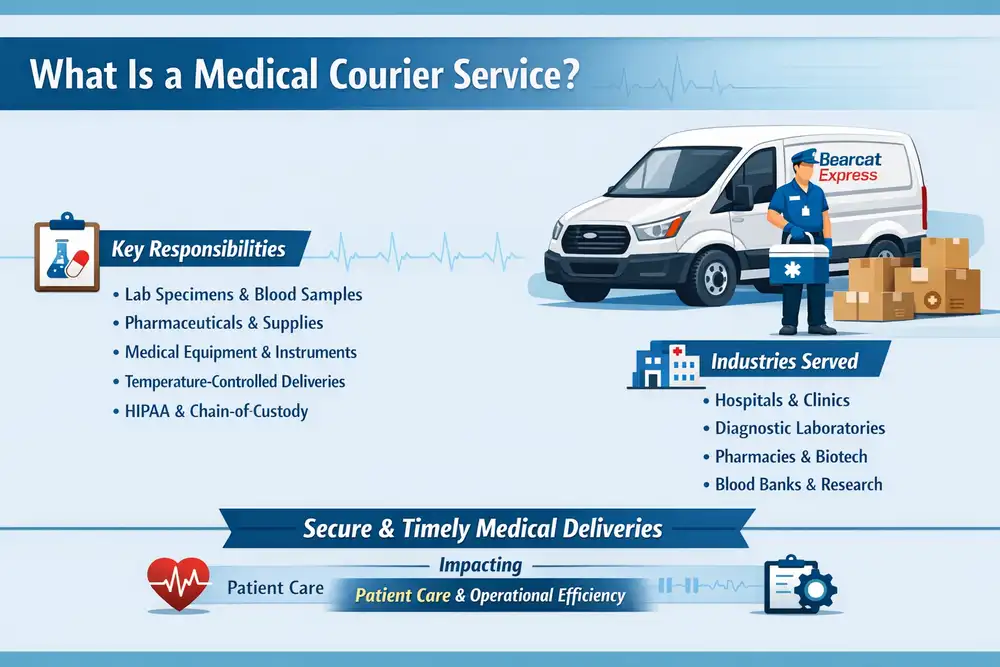
A medical courier service is the specialized transport of items such as lab specimens, blood products, prescriptions, pharmaceuticals, and medical equipment between clinics, labs, pharmacies, and hospitals. Unlike a standard package delivery, every step follows documented handling and compliance protocols.
Role of Medical Couriers in Healthcare Logistics
Medical couriers sit at the center of the healthcare supply chain. They handle:
- Timely transport of diagnostic samples
- Safe handling of biohazard and sensitive materials
- Chain-of-custody documentation for every stop
- Fast turnaround windows that directly affect patient care
Why They Are Different from Regular Couriers
A regular parcel driver is not trained to handle a leaking specimen bag or a temperature-sensitive vaccine shipment. Medical couriers carry specific training in bloodborne pathogen handling, HIPAA awareness, and cold-chain procedures, which is one of the main reasons medical deliveries cost more than a standard drop-off.
Bearcat Express builds these standards into every route we run, whether it is a single lab pickup or a full scheduled contract for a regional clinic network.
Why Medical Courier Costs Matter in Healthcare
Impact on Patient Care & Lab Results
A delayed specimen is not just a logistics problem. It can push back a diagnosis, delay a treatment decision, or force a patient to redo a blood draw. Pricing decisions in this industry are really care-timeline decisions in disguise.
Importance of Speed, Accuracy, and Compliance
Clinics weigh three things when comparing medical courier service rates: how fast the item arrives, how few errors occur along the way, and whether the provider can prove compliance if something goes wrong.
Cost vs Reliability Trade-off
Choosing the lowest medical courier rates on paper often backfires. A missed STAT pickup or a mishandled specimen costs far more in redone tests, delayed care, and staff time than the few dollars saved on a cheaper vendor.
Real Medical Courier Rate Ranges in 2026
Rates by Mileage Bracket
For standard local service, most providers price in mileage tiers rather than a flat per-mile number, since short trips carry a fixed base cost regardless of distance.
| Distance | Standard Service | Rush (2-hour) Service |
| 0 to 10 miles | $26 to $36 | $40 to $50 |
| 11 to 15 miles | $32 to $42 | $46 to $56 |
| 16 to 20 miles | $38 to $48 | $52 to $62 |
| 21 to 25 miles | $44 to $56 | $58 to $70 |
Rates by Service Tier
- Scheduled route (daily pickup): lowest cost per stop, billed monthly or per contract
- Standard same-day: moderate, usually a flat base fee plus mileage
- 2-hour rush: a defined premium above standard
- STAT/emergency: the highest tier, priced for immediate dispatch
Average Cost Per Mile Explained
When a job is billed purely by distance rather than by tier, the average cost per mile for medical deliveries typically sits between $1.25 and $3.00, with the higher end reserved for refrigerated or hazardous-material handling.
How Your Quote Is Actually Calculated
Base Fee + Per-Mile Rate + Urgency Tier + Surcharges
Most quotes are not one number pulled from a chart. They are built from four layers: a base pickup fee, a mileage charge, an urgency multiplier if the job is rushed, and any surcharges for special handling. Understanding this formula helps you predict your own medical courier service rates before you ever request a quote.
Flat Rate vs Distance-Based Pricing
A flat rate works well for a short, predictable clinic-to-lab run. Distance-based pricing makes more sense once routes stretch across a wider service area, since it scales fairly with the actual miles driven.
Monthly & Contract Pricing for Hospitals and Labs
Hospitals and high-volume labs almost always negotiate contract pricing instead of paying per trip. Locking in a monthly rate based on projected stop count is one of the most effective ways to control medical supply delivery costs over a full year.
Inside a Same-Day Dispatch Desk: How We Build a Live Quote
Most guides stop at listing the factors that affect price. Here is what actually happens on our dispatch floor when a clinic calls in a request, so you can see how those factors turn into a real number.
Step 1: Pickup Zone & Base Fee
The dispatcher first confirms the pickup zone. Augusta metro pickups start at a base fee, while requests from outlying service areas add a small zone adjustment before mileage is even calculated.
Step 2: Mileage & Route Complexity
Next, the system calculates the actual drive distance and checks for route complexity such as multiple stops, restricted-access buildings, or loading dock waiting time.
Step 3: Urgency Tier Applied
The requester chooses standard, 2-hour, or STAT. This is where the biggest swing in price happens, since a STAT request pulls a driver off an active route or dispatches a dedicated vehicle.
Step 4: Specialized Handling Add-ons
If the item needs refrigeration, dry ice, or extra documentation for chain of custody, that add-on gets applied last.
Sample Quote Breakdown
| Line Item | Example Charge |
| Base pickup fee (Augusta zone) | $18 |
| Mileage (14 miles) | $12 |
| Urgency tier (2-hour rush) | +$20 |
| Temperature-controlled handling | +$15 |
| Total quoted price | $65 |
This is the kind of transparency clinics rarely get from a generic rate sheet, and it is exactly why we walk every new client through their first quote line by line.
Factors That Influence Medical Courier Pricing
- Distance & Delivery Zones: Longer routes and rural stops raise the cost.
- Urgency of Service: Standard versus STAT is the single biggest price driver.
- Type of Medical Item: Blood samples, lab specimens, pharmaceuticals, and organs each carry different handling requirements.
- Temperature-Controlled Handling: Cold-chain logistics add equipment and monitoring costs.
- Compliance & Certification: HIPAA and biohazard training add operational overhead.
- Technology & Chain of Custody: Real-time tracking systems improve safety but add cost.
- Frequency of Deliveries: Regular routes reduce the per-trip price.
- Time of Delivery: After-hours and weekend runs usually include a surcharge.
Cost by Vehicle Type
Not every job needs the same vehicle, and that changes the price. A sedan works fine for a handful of blood tubes. A cargo van is needed for bulkier equipment or multi-stop routes. A refrigerated unit, reserved for vaccines and temperature-sensitive pharmaceuticals, carries the highest per-mile cost because of the equipment and monitoring involved. Clinics that assume every delivery costs the same regardless of vehicle are often surprised when a specialized item comes in at a higher quote.
Medical Courier Pricing Models Explained
Per-Mile Pricing Model
Common for on-demand, single-trip medical deliveries, especially within a local service radius.
Flat Rate Pricing Model
Used for predictable, repeating routes like a clinic-to-lab pickup that runs the same path every day.
On-Demand vs Scheduled Delivery Pricing
On-demand requests cost more because they require immediate dispatch. Scheduled delivery is more cost-efficient since it lets a provider plan routes in advance.
Subscription / Contract-Based Pricing
Best suited for hospitals and labs with consistent daily volume, since contract pricing locks in predictable monthly costs.
In-House Fleet vs Outsourced Medical Courier: Cost Comparison
Hidden Costs of Running an In-House Fleet
An in-house fleet looks cheaper on paper until you add vehicle maintenance, driver payroll, insurance, fuel, and compliance training. Many clinics underestimate these line items when comparing against outsourced medical courier service rates.
Typical Savings from Outsourcing
Healthcare providers that switch from an in-house fleet to an outsourced medical courier often see meaningful savings once payroll, insurance, and vehicle costs are removed from the equation, particularly for organizations that do not have enough daily volume to keep a full-time driver busy.
When In-House Still Makes Sense
Very high-volume hospital systems with dozens of daily stops sometimes still benefit from a dedicated in-house team. For most clinics and independent labs, outsourcing remains the more cost-effective path.
Local vs National Medical Courier Services (Cost Comparison)
Local Courier Providers
Local providers typically offer lower medical courier rates, faster response times, and more flexible scheduling because they know the service area well.
National Healthcare Logistics Companies
National companies bring stronger standardized compliance systems and broader coverage, usually at a higher price point.
Which Option Is More Cost-Effective?
For most clinics searching for a medical courier near me, a local provider offers better value unless the organization needs multi-state logistics coordination.
Why Medical Courier Services Cost More Than Regular Couriers
Healthcare Compliance Requirements
Strict regulatory obligations increase operational overhead compared to standard parcel delivery.
Time-Sensitive Deliveries
Medical urgency demands priority routing that a regular courier network is not built to prioritize.
Specialized Equipment & Training
Drivers need certification in bloodborne pathogen handling and cold-chain procedures.
Risk Management and Liability Coverage
Higher insurance costs are built directly into medical courier pricing to cover the added liability of handling regulated materials.
What Non-Compliance Actually Costs
HIPAA Violation Penalty Ranges
This is the part most pricing guides skip. A HIPAA violation tied to mishandled patient information during a delivery can carry civil penalties ranging from a few hundred dollars per incident up to tens of thousands of dollars, with willful neglect cases reaching into six figures. That risk is exactly why compliant medical courier service rates are higher than a generic delivery app.
Why Cheap Non-Compliant Couriers Cost More Long-Term
A bargain courier that cannot produce a chain-of-custody log or sign a compliance agreement is not actually saving you money. One flagged incident during an audit can cost far more than years of paying a fair rate for a properly trained provider.
Hidden Fees in Medical Courier Services (2026 Insight)
- Fuel Surcharges: Adjust with market fuel prices.
- After-Hours Fees: Night and weekend medical deliveries typically cost more.
- Emergency STAT Charges: Premium pricing for immediate dispatch.
- Temperature-Control Add-ons: Extra cost for cold-chain equipment and monitoring.
- Waiting Time & Zone-Based Fees: Extended wait time at a loading dock or reception desk, and pickups from outlying zones, often carry their own line-item charge that many quotes bury in the fine print.
How to Reduce Medical Courier Costs
Using Scheduled Routes Instead of On-Demand
Switching predictable pickups to a scheduled route is one of the fastest ways to lower ongoing medical supply delivery costs.
Long-Term Contract Agreements
Hospitals and labs that commit to a contract typically unlock better per-stop pricing than one-off requests.
Route Optimization & Batch Deliveries
Combining multiple pickups into a single optimized route reduces the per-trip cost for everyone involved.
Reducing Emergency Dispatch Frequency
Better internal planning around specimen collection times reduces how often a clinic needs to pay for expensive STAT service.
Industries That Rely on Medical Courier Services
Hospitals & Clinics
Daily use for lab samples, reports, and inter-department transfers.
Diagnostic Laboratories
High-volume medical deliveries supporting testing turnaround times.
Pharmaceutical Companies
Distribution of sensitive medications that require verified chain of custody.
Blood Banks & Research Centers
Critical temperature-controlled transport where a delay is not an option.
Is Medical Courier Service Worth the Cost?
Speed vs Risk Reduction Benefits
Faster, properly handled delivery directly reduces clinical risk.
Impact on Diagnosis and Treatment Outcomes
Timely specimen delivery improves diagnostic accuracy and shortens the path to treatment.
Long-Term Cost Efficiency
Reliable logistics reduce redone tests, missed windows, and the operational drag of unreliable delivery.
For businesses looking for fast regional logistics beyond medical routes, our Same Day Delivery Service Augusta GA page covers how we support time-sensitive deliveries across the broader service area.
How to Choose the Right Medical Courier Service
- SLA Expectations: Get a written service-level agreement, not a verbal promise.
- Driver Certification & Training: Confirm bloodborne pathogen and HIPAA training.
- Chain-of-Custody Tracking: Ask how every handoff is logged.
- Temperature-Control Capability: Verify actual monitoring, not just an insulated bag.
- ETA Accuracy & Reliability: Ask for real performance data, not just a promise.
- Pricing Transparency Checklist: A trustworthy provider should be able to explain every line item on your quote without hesitation, the same way we break it down above.
Future Trends in Medical Courier Costs (2026 and Beyond)
Automation & Real-Time Tracking
Technology is improving transparency in medical deliveries, giving clinics live visibility into every stop.
Rising Demand for Same-Day Healthcare Logistics
Demand for a reliable medical courier near me option keeps climbing as clinics decentralize testing and treatment.
AI Route Optimization
Smarter routing reduces wasted miles, which should help stabilize medical courier rates over time.
Increased Compliance Costs
Expect regulatory requirements to keep tightening, which will likely keep compliant medical courier service rates from dropping much further.
Final Thought
Understanding how much a medical courier service costs really comes down to matching urgency, item type, and volume to the right pricing model. Whether you run a single clinic or a multi-site lab network, the goal is the same: predictable medical courier service rates that do not sacrifice compliance or speed.
At Bearcat Express, we build every quote around that same transparency, from a single STAT run to a full scheduled contract. If you are ready to get a clear quote for your medical deliveries, reach out through our Contact Us page and we will walk you through real pricing for your specific route.
Frequently Asked Questions
How much does a medical courier cost per mile?
Most medical courier rates fall between $1.25 and $3.00 per mile when billed by distance, though many providers use flat or tiered pricing for short local routes.
Are medical courier services available 24/7?
Yes, most established providers offer around-the-clock coverage for STAT and emergency medical deliveries, since patient needs do not follow business hours.
What affects medical courier pricing the most?
Urgency has the biggest impact on medical courier service rates, followed by distance, item type, and whether temperature-controlled handling is required.
Do medical couriers handle emergency STAT deliveries?
Yes, STAT service is a core offering for urgent healthcare needs, though it is priced at a premium because it requires immediate dispatch and dedicated routing.
How do I calculate my expected medical courier cost?
Start with the base fee for your zone, add the per-mile charge for your route, apply the urgency tier you need, then add any handling surcharges. This is the same four-step formula dispatchers use to build a live quote.