In today’s fast-moving logistics world, businesses expect shipments to arrive quickly and reliably. A key part of this process is understanding the difference between intermodal and multimodal transport. While both involve multiple transportation modes, they differ in management, responsibility, and efficiency. These differences directly impact cost, delivery speed, and overall performance.
At Bearcat Express, we handle shipments that move through these systems before final delivery. Knowing how they work helps businesses make smarter logistics decisions. In this guide, we explain the intermodal meaning, the multimodal definition, and compare both methods to help you choose the right shipping approach.
What Is Multimodal Transportation?
Simple Definition
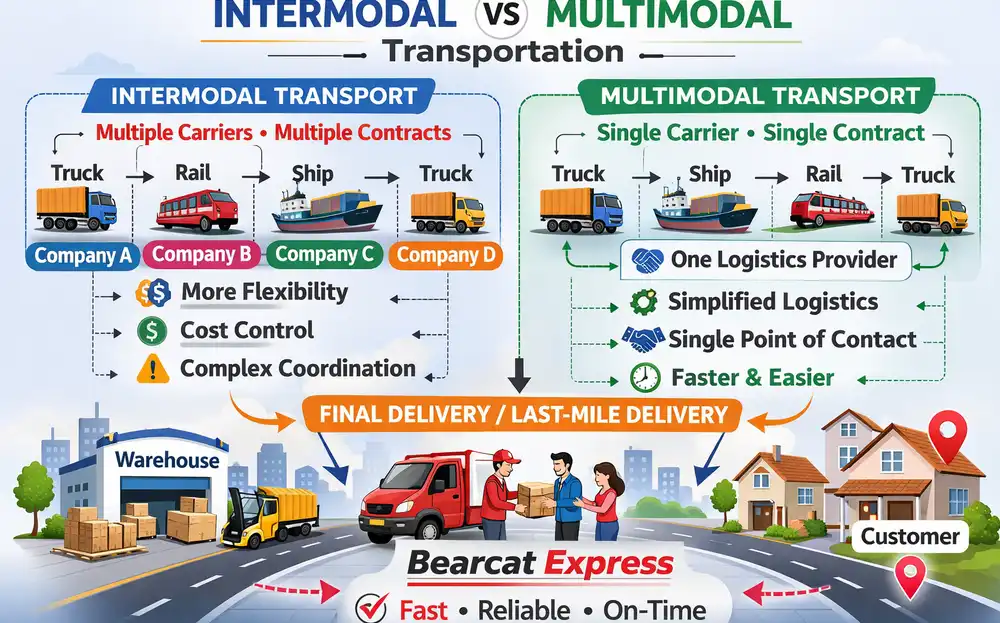
The multimodal definition refers to a transportation method where goods are moved using multiple modes (such as truck, rail, air, or sea) under a single contract and a single carrier.
In simple terms, one company is responsible for the entire journey, even though different transport methods are used.
How It Works
Multimodal transport simplifies logistics by placing full responsibility on one provider. That provider coordinates every stage, including:
- Pickup from origin
- Transfer between transport modes
- Final delivery
The customer only deals with one contract, one invoice, and one point of contact. This streamlined approach is often preferred by businesses that want simplicity and reliability, something companies like Bearcat Express understand well when handling final delivery operations.
Real-World Example
Imagine a business shipping products from overseas:
- Goods are picked up by truck
- Loaded onto a cargo ship
- Transferred to the rail
- Delivered locally by truck
Even though multiple transport modes are used, it’s all handled by one logistics provider. That’s multimodal transport.
What Is Intermodal Transportation?
Simple Definition
The intermodal definition refers to a transportation method where goods are moved using multiple modes, but each segment is managed by a different carrier under separate contracts.
How It Works
In intermodal transport:
- Each stage of the journey is handled by a different company
- Containers are used to keep goods secure during transfers
- Coordination is required between multiple providers
Unlike multimodal transport, there is no single point of responsibility.
Example
A shipment may follow this route:
- The truck company picks up goods
- Rail company handles long-distance transport
- Another trucking company completes final delivery
Each stage involves a separate agreement. This is a classic example of intermodal transport.
Intermodal vs Multimodal Transportation (Key Differences)
Understanding the difference between intermodal and multimodal transport becomes easier when you compare them side by side.
| Factor | Multimodal Transport | Intermodal Transport |
| Contracts | Single contract | Multiple contracts |
| Responsibility | One carrier | Multiple carriers |
| Coordination | Simple | Complex |
| Cost Control | Less flexible | More flexible |
| Risk Management | Centralized | Shared across providers |
| Flexibility | Limited | High |
This comparison clearly shows that while multimodal transport focuses on simplicity, intermodal transport offers greater flexibility and control.
Advantages of Multimodal Transportation
Multimodal transport is widely used because it simplifies the shipping process.
Simplified Logistics
With one contract and one provider, businesses don’t have to manage multiple carriers or agreements.
Single Point of Contact
All communication is handled through one company, reducing confusion and delays.
Faster Coordination
Since one provider manages everything, transitions between transport modes are smoother and quicker.
Advantages of Intermodal Transportation
Intermodal transport offers benefits for businesses that want more control over their logistics.
Cost Efficiency
Companies can choose different carriers for each stage, allowing them to optimize costs.
Flexibility
Businesses can adjust routes, carriers, and schedules based on changing needs.
Better Control
Since each segment is handled separately, companies have more visibility and control over the process.
Disadvantages of Intermodal and Multimodal Transportation
No system is perfect, and both methods have limitations.
Intermodal Transport Challenges
- Requires coordination between multiple carriers
- Higher risk of delays due to miscommunication
- More complex management
Multimodal Transport Challenges
- Less control over individual segments
- Dependence on a single provider
- Limited flexibility in changing routes
Understanding these trade-offs is key when evaluating the difference between intermodal and multimodal transport.
When to Use Intermodal vs Multimodal Transportation
Choosing the right method depends on your specific shipping needs.
Based on Shipment Size
- Large shipments → Intermodal transport is often more cost-effective
- Smaller or simpler shipments → Multimodal transport works better
Based on Urgency
- Urgent deliveries → Multimodal transport is usually faster due to centralized coordination
- Non-urgent shipments → Intermodal transport can reduce costs
Based on the budget
- Tight budgets → Intermodal allows cost optimization
- Predictable pricing → Multimodal is easier to manage
Business Use Cases
- eCommerce → Multimodal for speed and simplicity
- Manufacturing → Intermodal for bulk shipping savings
Real-Life Example of Intermodal vs Multimodal Shipping
Let’s break this down with a simple scenario.
A retailer imports products from another country:
Multimodal Scenario
- One logistics provider manages the entire journey
- Goods move from ship → rail → truck
- Final delivery is handled seamlessly
Intermodal Scenario
- Shipping company handles ocean freight
- The rail company transports inland
- Local trucking company completes delivery
Both reach the same destination, but the process and management differ significantly.
How Courier Services Fit Into Intermodal and Multimodal Transportation
No matter which method is used, one stage remains critical: the final delivery.
This is where courier services play a key role.
Once shipments arrive at a local hub, they still need to reach the customer. Services like:
- Last-mile delivery
- Local distribution
- Same-day delivery
ensures the shipment completes its journey successfully.
For example, businesses relying on a Same Day Delivery Service in Augusta, GA, depend on reliable courier providers to handle urgent deliveries once goods arrive locally.
At Bearcat Express, this final step is where precision, speed, and customer satisfaction matter most. Even the most efficient transport system can fail without a strong last-mile solution.
Which Is Better: Intermodal or Multimodal Transportation?
The answer depends on your priorities.
Choose Multimodal Transport if:
- You want simplicity
- You prefer a single point of contact
- You need faster coordination
Choose Intermodal Transport if:
- You want cost flexibility
- You need control over each stage
- You’re managing large or complex shipments
There is no universal “best” option; there is only the one that fits your business needs.
You may also read: What is Pool Distribution
Conclusion
Understanding the difference between intermodal and multimodal transport is essential for making informed logistics decisions. While both methods use multiple transport modes, they differ in contract terms, responsibilities, flexibility, and overall control. Multimodal transport offers simplicity and streamlined coordination, while intermodal transport provides flexibility and cost control. The right choice depends on your shipment size, urgency, and business priorities.
No matter which method you choose, the final delivery stage remains critical. Reliable courier services ensure that goods reach their destination safely and on time. If you’re looking for dependable last-mile solutions, contact us at Bearcat Express to ensure your deliveries are handled with speed, accuracy, and care.
FAQs
What is the main difference between multimodal and intermodal transport?
The main difference between multimodal and intermodal transport is that multimodal uses a single contract and carrier, while intermodal involves multiple carriers and contracts for each stage.
Which is cheaper: intermodal or multimodal transport?
Intermodal transport is often cheaper because businesses can choose cost-effective carriers for each segment, while multimodal transport offers convenience at a slightly higher cost.
Which is faster: intermodal vs multimodal?
Multimodal transport is usually faster due to centralized coordination, while intermodal may involve delays because of multiple handoffs.
Is multimodal transport more efficient?
Multimodal transport is more efficient in terms of management and coordination, but intermodal transport can be more efficient in cost optimization depending on the shipment.
Where is intermodal transportation used?
Intermodal transportation is commonly used in long-distance shipping, especially for bulk goods moved via rail, sea, and truck combinations.