Ever tracked a shipment moving from truck to train and back to truck again? That is freight logistics at work. The difference between intermodal and multimodal transport comes down to one thing: who is responsible for your cargo once it leaves your hands.
At Bearcat Express, we work with businesses across Georgia and Alabama shipping everything from urgent documents to bulk freight, and we often get asked which method actually fits a specific load. This guide breaks down both terms in plain language, using real scenarios instead of textbook definitions, so you know exactly which option protects your shipment.
Intermodal vs Multimodal: Quick Answer
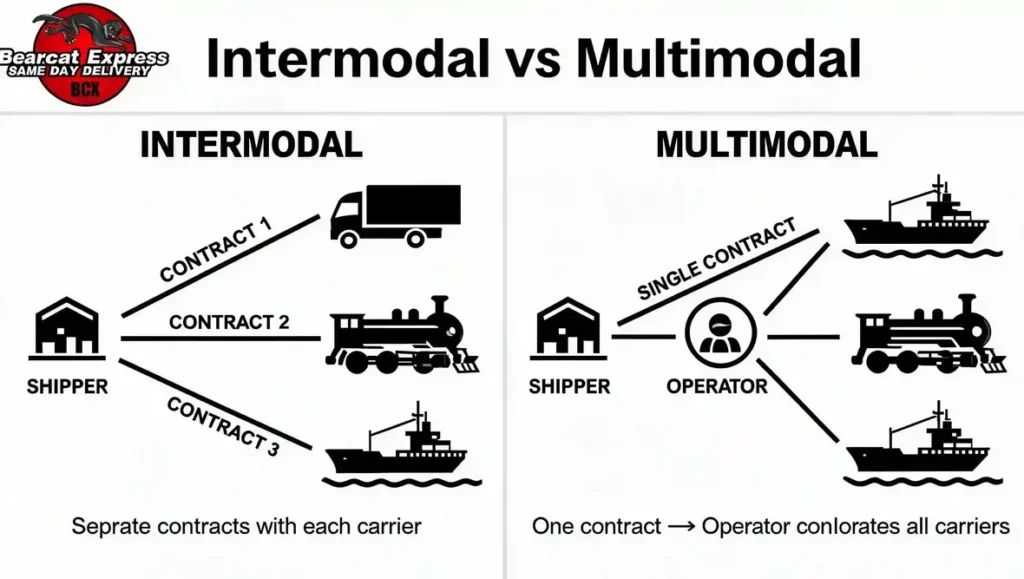
In simple terms, intermodal transportation uses multiple modes of transport (truck, rail, ship) but involves separate contracts with separate carriers for each leg of the journey. Multimodal transportation also uses multiple modes, but a single carrier manages the entire trip under one contract. The intermodal definition centers on divided responsibility across carriers, while the multimodal definition centers on one company owning the whole route. Neither is universally better. The right choice depends on your shipment size, timeline, and how much control you want over each leg of the trip.
What Is Intermodal Transportation?
Simple Definition
The intermodal meaning is straightforward once you strip away the industry jargon. Intermodal transportation refers to moving freight using two or more transport modes, where the cargo itself stays in the same container or trailer the entire time, but different companies handle different legs of the journey. A rail company might move the container across the country, then hand it off to a trucking company for the final stretch to your warehouse.
How It Works
Because intermodal shipping involves multiple carriers, you typically sign separate agreements with each one. This means you are the point of contact if a rail delay pushes back your delivery window, or if a trucking partner needs updated paperwork before pickup. The intermodal definition assumes the shipper is comfortable coordinating between vendors, which works well for companies with dedicated logistics staff but can be a headache for smaller operations juggling other priorities.
Common Types
Two structures come up most often in everyday freight movement.
Container-On-Flat-Car (COFC)
This setup loads a standard shipping container directly onto a rail flatcar without a chassis underneath. It is common for long-distance freight moving from ports to inland distribution centers, since containers can be lifted straight off ships onto rail cars without repacking.
Trailer-On-Flat-Car (TOFC)
Also called piggyback shipping, this method loads an entire truck trailer, wheels and all, onto a rail flatcar. It is slightly older technology than COFC but still used by carriers who want flexibility to move trailers directly onto highways at the destination rail yard without needing separate lifting equipment.
What Is Multimodal Transportation?
Simple Definition
The multimodal definition is centered on simplicity for the shipper. A single carrier, sometimes called a multimodal transport operator, takes responsibility for your freight from pickup to final delivery, even though the actual physical movement might involve a truck, then a ship, then another truck. You sign one contract, get one bill of lading, and call one company if anything needs tracking down.
How It Works
The multimodal operator subcontracts the individual legs to trucking companies, rail lines, or ocean carriers behind the scenes, but you never have to manage those relationships directly. If a shipment gets delayed on the ocean leg, it is the multimodal operator’s job to sort it out and update you, not yours to chase down three different companies.
Real-World Example
Picture a furniture manufacturer in Alabama shipping a container of goods to a distributor in another state. Using multimodal transportation, they would work with one logistics company that arranges the truck pickup, the rail leg, and the final truck delivery, and that company remains accountable for the entire move under a single agreement. The manufacturer gets one invoice and one point of contact instead of coordinating three separate vendor relationships.
Key Differences Between Intermodal and Multimodal Transport
The table below summarizes where these two methods actually diverge.
| Factor | Intermodal | Multimodal |
| Contracts | Multiple, one per carrier | Single contract for full journey |
| Liability | Split across carriers | Centralized with one operator |
| Cost | Often lower, but variable | Slightly higher due to coordination fees |
| Flexibility | High, can swap carriers per leg | Lower, locked into one operator’s network |
| Coordination Effort | Shipper manages multiple vendors | Operator manages everything |
This comparison is really the heart of the difference between multimodal and intermodal transport. Everything else- cost, speed, and risk- flows from this basic split in who holds the contract.
Advantages and Disadvantages
Intermodal Pros and Cons
Intermodal shipping tends to offer better rates because you can shop each leg separately and pick the most competitive carrier for that segment. It also gives you flexibility to swap out an underperforming carrier without renegotiating the entire shipment. The tradeoff is coordination complexity. If a rail carrier and a trucking company disagree on a handoff schedule, you are the one stuck resolving it, and that can eat up staff time that a smaller business may not have to spare.
Multimodal Pros and Cons
Multimodal transportation shines when you want one throat to choke, so to speak, and a single point of contact for tracking and accountability. Delivery timelines also tend to be more predictable since one operator is managing the full route rather than depending on handoffs between separate companies. The downside is cost. Multimodal operators build coordination and risk management into their pricing, so you often pay a premium compared to arranging each intermodal leg yourself.
When Should a Business Choose Intermodal vs Multimodal?
Based on Shipment Size and Budget
Smaller businesses moving occasional freight often benefit from multimodal transportation simply because they lack the internal staff to manage multiple carrier relationships. Larger operations with dedicated logistics teams and frequent, high-volume shipments can extract real savings from intermodal transportation by negotiating each leg independently.
Based on Urgency and Delivery Timeline
If a shipment absolutely has to arrive by a fixed date, multimodal transportation’s single point of accountability usually wins, since there is one company responsible for the whole schedule. Intermodal transportation can be cheaper but introduces more risk of delay whenever a handoff between carriers does not go smoothly.
Real-Life Scenario
A wholesale distributor based near Augusta needed to move a full truckload of inventory from a regional warehouse to a retail partner three states away. They chose multimodal transportation because their small operations team could not afford to spend hours each week checking in with separate rail and trucking vendors. The single contract meant that when a rail delay came up, the multimodal operator absorbed the problem and rerouted without the distributor needing to intervene.
Where Local Same-Day Courier Services Fit In
Here is where things get practical for many businesses. Intermodal and multimodal transportation both apply to long-haul, cross-country, or international freight that involves multiple transport modes over days or weeks. Neither one is designed for the kind of urgent, local, or regional delivery that businesses in Georgia and Alabama frequently need.
If your shipment is a same-day document delivery, a time-sensitive parcel, or a local business-to-business transfer, intermodal and multimodal shipping methods are simply the wrong tool for the job. This is where a dedicated regional courier comes in. Bearcat Express handles exactly this kind of urgent, local, and regional movement, offering direct pickup and delivery without the layered handoffs that intermodal and multimodal systems require. For businesses in the Augusta area needing something delivered within hours rather than days, our Same Day Delivery Service Augusta GA page outlines exactly how that process works.
Choosing between intermodal transportation and multimodal transportation only matters once your shipment is genuinely long-distance freight. For anything local and urgent, a same-day courier removes the entire question.
You may also read: What is Pool Distribution
Which Option Is Better for Your Shipment?
Choose Multimodal If
You want a single company accountable for the entire journey, your timeline is fixed and cannot slip, and you do not have staff available to coordinate multiple carrier relationships.
Choose Intermodal If
You have the internal capacity to manage separate carrier contracts, cost savings matter more than convenience, and your shipment has some flexibility in delivery date if a handoff runs late.
Conclusion
Understanding the difference between intermodal and multimodal transport helps you avoid paying for the wrong kind of shipping or handing your freight to the wrong type of carrier. The multimodal definition centers on simplicity and single accountability, while intermodal transportation rewards businesses with the staff and time to manage multiple carrier relationships directly.
But if your actual need is a fast, local, or regional delivery rather than long-haul freight, none of this applies to you in the first place. Bearcat Express specializes in exactly that kind of urgent, regional movement across Georgia, Alabama, and nearby areas. Contact us today to talk through your delivery timeline and find the right solution for your next shipment.
FAQs
What is the main difference between multimodal and intermodal transport?
The difference between multimodal and intermodal transport comes down to contracts and liability. Intermodal involves separate contracts with each carrier for each leg, while multimodal uses a single contract with one operator managing the entire journey.
Is intermodal transportation cheaper than multimodal transportation?
Intermodal transportation is often cheaper because you can negotiate each leg separately with different carriers. Multimodal transportation tends to cost more due to the coordination and risk management the single operator builds into their pricing.
Can a small business use intermodal shipping without a logistics team?
It is possible but difficult, since intermodal transportation requires managing multiple carrier relationships and handoffs. Most small businesses without dedicated logistics staff find multimodal transportation easier to manage day to day.
Does intermodal or multimodal transport work for urgent local deliveries?
Neither is designed for urgent local deliveries, since both are built for long-distance, multi-day freight movement. A regional same-day courier is the better fit when speed and locality matter more than long-haul volume.
What does Container-On-Flat-Car mean in intermodal shipping?
Container-On-Flat-Car, or COFC, refers to loading a standard shipping container directly onto a rail flatcar without a wheeled chassis. It is a common intermodal method for moving freight efficiently from ports to inland rail yards.