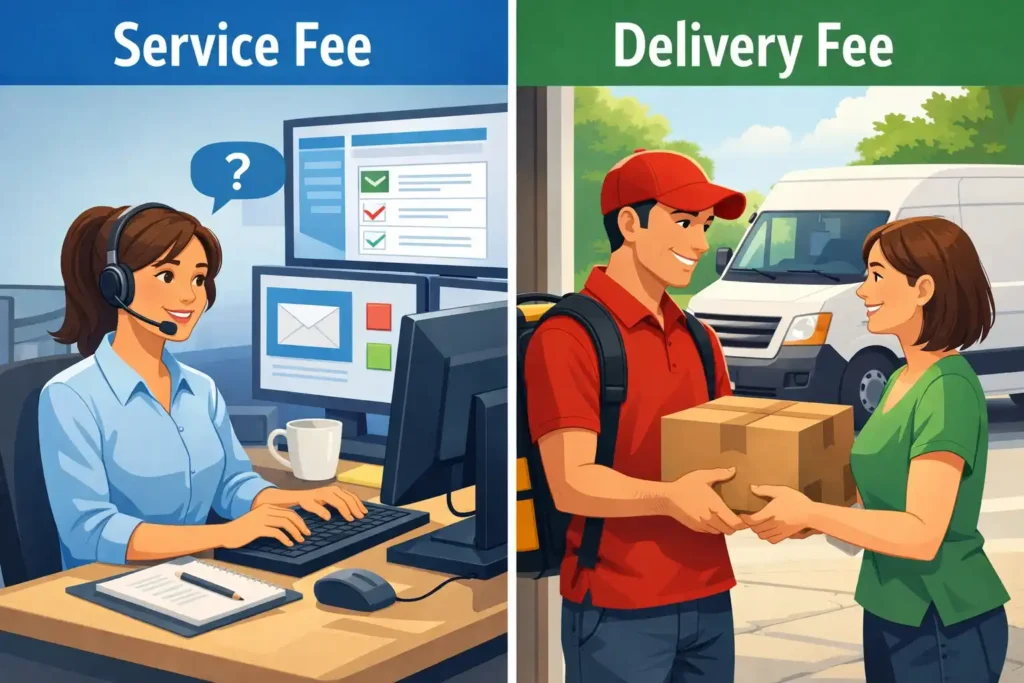
You book a courier pickup, get your invoice, and see two separate charges you weren’t expecting: a service fee and a delivery fee. Are they the same thing billed twice? Is one of them padding the price? The Difference Between Service Fee and Delivery Fee actually comes down to what each charge is paying for. One covers the work behind the scenes that gets your shipment booked, scheduled, and tracked.
The other covers the physical job of getting it from point A to point B. At Bearcat Express, we get asked about this almost every week, usually right after someone opens an invoice and starts counting line items. This guide breaks both fees down in plain terms, using real examples from how courier pricing actually works, not just textbook definitions.
Table of Contents
ToggleWhat Is a Service Fee?
Service Fee Definition Explained
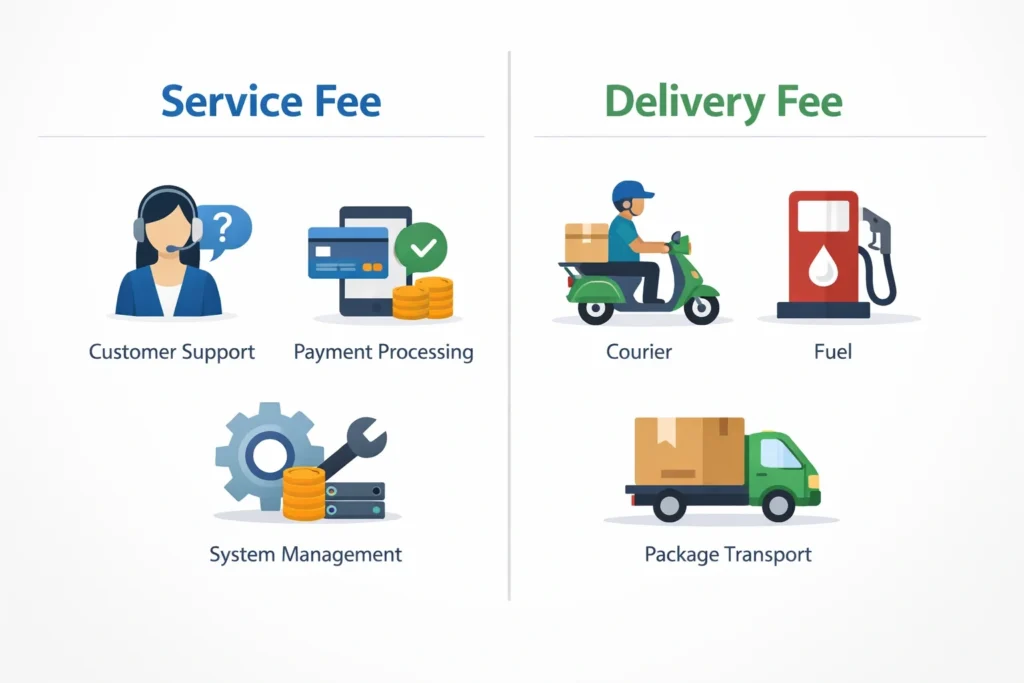
A simple service fee definition looks like this: it’s a fee paid for a service, not for the movement of a package itself. When you book a courier run, someone has to receive your request, confirm pickup details, assign a driver, and keep the shipment tracked from start to finish. That coordination work is what the service fee pays for. It’s the same reason a bank charges a small fee for processing a wire transfer separately from the amount being sent. The transfer and the processing are two different jobs, so they get billed as two different things.
So if someone asks what is the service fee in the context of a courier order, the short answer is that it’s a fee paid for a service the company performs to make the delivery happen smoothly, not the delivery itself.
Why Courier Companies Charge It
Courier companies charge a service fee because dispatch and admin work costs money whether or not a truck ever leaves the lot. Someone is answering the phone, confirming addresses, checking special handling requests, and making sure the right driver with the right vehicle gets assigned. For same-day or rush orders, this work gets more intense. A dispatcher might need to re-route an existing driver, call ahead to confirm a receiving dock is open, or flag a fragile item so it gets loaded correctly. None of that shows up as miles on an odometer, but it’s real labor that keeps a delivery on schedule. That’s the practical reason a service fee definition always centers on coordination, not transportation.
What Is a Delivery Fee?
Delivery Fee Definition Explained
If a service fee pays for the planning, a delivery fee pays for the execution. So what is a delivery fee, exactly? It’s the charge tied directly to the physical act of getting your package from pickup to drop-off. This covers driver time, vehicle wear, fuel, and the actual distance traveled. Where a service fee stays roughly steady no matter what you’re shipping, a delivery fee moves depending on the specifics of the run.
How Delivery Fees Are Calculated
Three things drive most delivery fee calculations: distance, vehicle type, and urgency. A courier run across town costs less than one that crosses three counties, simply because of drive time and fuel. Vehicle type matters too. A small parcel that fits in a sedan costs less to move than a large item requiring a cargo van or a two-person lift. Urgency changes the math again. A scheduled next-day pickup can be planned around existing routes, but a same-day rush request often means pulling a driver off another job or dispatching a dedicated run, which raises the delivery fee accordingly.
Why Companies Split the Fee Instead of Charging One Flat Price
It might seem simpler to just charge one flat number and call it a day. Here’s why that doesn’t actually work well for either the courier or the customer. A flat rate has to assume an average cost across every possible scenario, which means light, local, simple orders end up subsidizing heavy, long-distance, complicated ones. Splitting the charge into service and delivery keeps pricing honest to what each specific order actually requires.
At Bearcat Express, our dispatch team builds quotes this way on purpose. When a call comes in, the coordination side gets priced based on how much handling the order needs, while the transport side gets priced based on distance, vehicle, and timing. That separation is what lets us quote a short local drop differently from a same-day cross-city rush, instead of forcing every customer onto one generic number that doesn’t fit their actual shipment.
What the Service Fee Covers Behind the Scenes
Behind a service fee, you’re paying for order intake, driver assignment, real-time tracking updates, and the customer support that steps in if something needs to change mid-route. If a receiving location is closed when a driver arrives, someone on the service and delivery coordination side has to make a quick call on rescheduling or rerouting. That kind of problem-solving is part of what the fee supports, even though it never appears as a visible task on your invoice.
What You’re Actually Paying for in the Delivery Fee
The delivery fee is more straightforward to picture. You’re paying a driver for their time behind the wheel, fuel for the trip, and the wear that comes from regular vehicle use. For larger or fragile shipments, it can also include the extra handling required to load and unload safely. This is why two deliveries of similar distance can carry different delivery fees. One might be a lightweight envelope, and the other a piece of equipment needing careful handling and a bigger vehicle.
How Separate Pricing Builds Customer Trust
When a business ships regularly, unclear pricing becomes a real problem over time. Splitting charges into a service fee and a delivery fee gives shippers a clear picture of what they’re paying for and why a price changes from one order to the next. A repeat customer can look at their invoice and understand exactly which part of the cost is driven by distance and vehicle needs, and which part covers coordination. That clarity matters more for businesses managing shipping budgets across dozens of monthly orders than it does for a one-time shipment.
Service Fee vs Delivery Fee Comparison
Category | Service Fee | Delivery Fee |
What it covers | Booking, dispatch, coordination, tracking | Driver time, fuel, vehicle, mileage |
How it’s calculated | Often a flat or order-based rate | Based on distance, vehicle type, urgency |
When it changes | Rarely changes for routine orders | Changes with every order’s specifics |
Who it compensates | Admin, dispatch, and support functions | The driver and the physical transport process |
Real Order Example: How the Two Fees Show Up on One Invoice
Here’s how this plays out on an actual order. A local business calls in a same-day request to move a set of boxed inventory from a warehouse to a retail location twelve miles away. The service fee on that invoice covers the intake call, the driver assignment, and the live tracking link sent to the customer. The delivery fee is calculated separately based on the twelve-mile distance, the cargo van needed for the box count, and the same-day urgency, since the driver had to be pulled from a lighter route to make the pickup window.
If that same business had scheduled the pickup two days in advance instead of requesting it same-day, the service fee would likely stay close to the same, but the delivery fee would probably come in lower, since the run could be planned into an existing route rather than dispatched as a rush job. That’s the clearest way to see the Difference Between Service Fee and Delivery Fee in practice: one reflects the coordination work, the other reflects the actual conditions of the run.
What Changes Each Fee
A few specific factors move these numbers up or down on any given order. Same-day requests almost always carry a higher delivery fee than scheduled pickups booked a day or more ahead, because rush orders require pulling resources from a planned route. Package size and weight affect vehicle selection, and a larger vehicle costs more to operate per mile. After-hours or weekend requests can raise both fees, since dispatch coordination outside normal hours takes more effort, and driver availability is more limited. Distance remains the most consistent factor for the delivery fee specifically, while the service fee stays comparatively stable unless the order needs unusual handling instructions.
How to Read Your Courier Invoice Correctly
For businesses that ship regularly, knowing how to read an invoice saves time and prevents confusion down the line. Start by separating the two line items mentally: one is for the work of arranging the shipment, the other is for the physical move. Check whether the delivery fee lines up with the distance and vehicle type used, since this is the number most likely to shift between orders. If a service fee looks unusually high, ask whether the order needed special handling, after-hours coordination, or last-minute rerouting, since those are the typical reasons it would increase. When customers call asking what is the service fee on a specific invoice, our dispatch team walks through the coordination work behind that exact order so the number makes sense before payment. Keeping a simple log of service and delivery charges across your regular shipments also makes it easier to spot patterns and budget more accurately for future orders.
Final Thought
Once you know what is a delivery fee versus what is the service fee, a courier invoice stops looking confusing and starts making sense. One line pays for the planning that gets your package where it needs to go. The other pays for the drive itself. Together, they reflect the real cost of moving something quickly and safely, whether that is a same-day request across Augusta or a scheduled pickup a few days out. Bearcat Express prices both fees the same way for every Same Day Delivery Service Augusta GA run, based on the actual coordination and distance involved rather than a flat guess. Contact us anytime if you have a specific order and want a straight answer on what it will cost.
Frequently Asked Questions
Is a service fee the same as a delivery fee?
No. A service fee covers the coordination and admin work behind booking and managing your shipment, while a delivery fee covers the physical cost of moving it, including driver time, fuel, and vehicle use.
Do I always pay both fees?
Most courier orders include both, since every shipment requires coordination as well as physical transport. Some providers bundle both into one displayed total, but the underlying cost structure still reflects both parts.
Can a service fee be waived?
It depends on the provider and the order type. Some businesses that ship in high volume or on a recurring contract basis may negotiate reduced service fees, but standard one-off orders typically include the full charge.
Does tipping replace the delivery fee?
No. A delivery fee is a required charge that covers the operational cost of the run itself. A tip is a separate, optional amount added on top to recognize good service, and it does not reduce or replace the delivery fee.
Why does my delivery fee change even for a similar distance?
Delivery fees respond to more than distance alone. Vehicle type, package size, and how urgently the order needs to move all factor into the final number, so two orders with similar mileage can still carry different fees.