
You paid for the order and got the confirmation email. Then the tracking page shows a label you didn’t expect: pending remote fulfillment. Nothing has shipped, nothing seems to be moving, and there’s no hint whether to wait a day or a month.
Quick answer: Most standard online orders clear this stage in one to three business days. Prepaid phone and SIM kit orders, backordered items, and anything moving between warehouses or across a border can stretch the wait from about three days to well over three weeks. So how long does pending remote fulfillment take for your order? It depends on the seller, the stock, and the route the item has to travel. Bearcat Express works on the delivery side of that journey, so this guide shows you how to read the status and judge whether the wait is normal.
What Does Pending Remote Fulfillment Mean
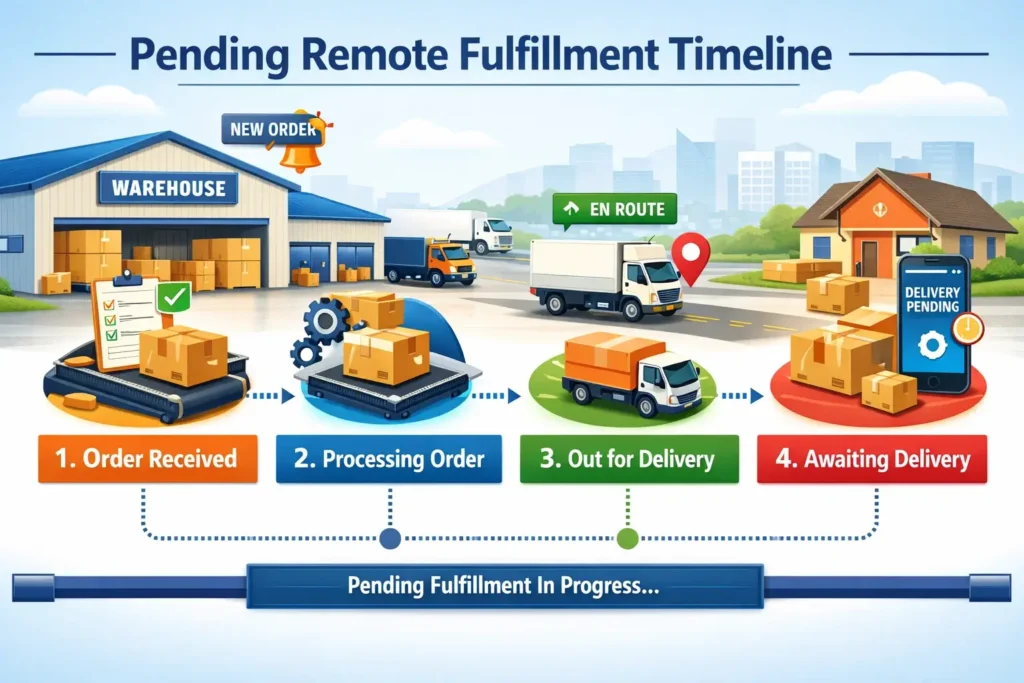
Pending remote fulfillment means the seller has accepted your order and your payment, but nobody has picked, packed, or handed the item to a carrier yet. The word ‘remote’ tells you the stock sits somewhere other than the seller’s main shipping point. That could be a partner warehouse, a regional overflow site, or a third-party logistics center that stores goods for several brands at once.
A remote fulfillment center is just a storage and shipping facility that runs apart from a retailer’s primary hub. Sellers use them to keep products closer to buyers, to carry slow-moving items without crowding headquarters, or to let another company handle the physical work.
So what does pending remote fulfillment mean in plain terms? Your order has been routed, but the hands-on work hasn’t started. It is a waiting line, not a failure. Plenty of shoppers expect a problem when they see the label, yet most of the time the system is doing exactly what it was built to do.
One thing the status does not tell you is whether the item is actually sitting on a shelf. That gap matters later.
How Long Does Pending Remote Fulfillment Actually Take
Every seller runs a different operation, so there is no universal number. There are, however, dependable patterns. Treat the ranges below as planning guides, not promises.
| Situation | Typical wait | Main driver |
| Standard in-stock order | 1 to 3 business days | Warehouse queue and weekend gaps |
| Multi-item order | Standard window plus extra days | The slowest item sets the pace |
| Backordered item | Days to weeks | Supplier restock date |
| Peak season or big promotion | Standard window plus extra days | Order volume |
| Cross-border or secondary warehouse transfer | Can run to several weeks | Export screening, trade compliance, customs |
| SIM kits | About 5 to 10 days | Promotion volume |
| Phones and hardware | About 2 to 4+ weeks | Promotion volume and warehouse transitions |
The search phrase pending remote fulfillment straight talk comes up mostly for those last two rows, since prepaid phone and SIM orders tend to run through busy promotions and warehouse changes. Cross-border orders have no fixed window at all, because each package has to clear export screening and border customs before a carrier can take it.
The honest answer to how long pending remote fulfillment takes is a range, not a figure. A related question, how long does order fulfillment take from payment to shipment, has the same shape: a day or three for a well-stocked seller, and much longer once stock has to travel.
The Pending Clock: What Should Happen at Hour 24, 48, 72, and Day 5
A single range doesn’t help when you’re staring at the screen on day two. This clock turns the wait into checkpoints you can act on. Count business days, since most warehouses don’t pick on weekends.
| Checkpoint | What’s normal | What to do |
| Hour 24 | Status hasn’t changed. Evening and weekend orders often wait for the next pick cycle. | Confirm your order email has an order number and that your payment shows as charged or on hold. |
| Hour 48 | Still pending, especially for multi-item or promotional orders. | Reread the product page and order details for ship-from notes, backorder labels, or an estimated ship date. |
| Hour 72 | You’ve reached the edge of the standard one- to three-business-day window. | Screenshot the status and keep your order number handy. No need to contact anyone yet. |
| Day 5 | The upper end of the 3 to 5 business day grace period many sellers need. | A polite check with support is fine now. Ask for the current ship estimate. |
| Day 7 and beyond | Past normal for most items. | Ask support to confirm the item is physically in stock, and check your bank or payment portal for a quiet refund. |
The clock exists to stop two mistakes: panicking on day one and doing nothing on day ten.
How the Remote Fulfillment Process Works
Knowing the steps makes the wait easier to read, and it explains why two orders placed minutes apart can move at different speeds.
- Order confirmation. Payment is verified, and the system chooses which location should fill the order. This takes seconds, but it sets the whole timeline.
- Inventory allocation. The remote site checks its physical shelves against the digital count. Small mismatches show up here, and this is where an order sits as pending because nothing has been touched yet.
- Picking and packing. Staff pull the item, check it against the order, and pack it for its handling needs. Fragile, oversized, or paperwork-heavy items take longer.
- Carrier handoff. A label is created, the carrier scans the package, and the status flips to shipped.
Many sites work in pick waves, so an order placed just after a cutoff waits for the next wave. That alone can separate two similar orders by a day. Only after the carrier scan does the delivery clock you actually care about begin.
Why Orders Get Stuck in Pending Remote Fulfillment
A status that lingers usually traces back to a short list of causes.
- Stock mismatch. The storefront shows the item as available, but the shelf count says otherwise. Customer discussion forums often point to this as the reason for long waits, and the usual ending is an automatic cancellation or refund instead of a shipment. It also explains many complaints about pending remote fulfillment straight talk orders during busy promotions, when the last units sell faster than the system updates.
- Peak volume. Holiday weeks and big promotions fill the pick queue. Even a well-staffed site can fall a day or two behind.
- Internal transfers. If your item sits at a secondary location, it may need to move to the warehouse that ships to your region before anyone can pack it. Distance doesn’t slow the packing itself, but transfers do.
- Third-party sync delays. When one company stores the goods and another runs the storefront, the two systems pass orders back and forth. Some connections update on a schedule instead of instantly, so an order can idle between them for hours.
- Customs and export checks. Cross-border stock has to clear export screening and trade compliance first. That is why sellers rarely commit to a firm date.
- Weekends and cutoffs. An order placed late Friday may not reach a picker until Monday. Nothing is wrong. The calendar just didn’t help.
Pending vs Awaiting Fulfillment vs Processing: What Is the Difference
These labels get mixed up constantly. Wording varies from store to store, so check the seller’s help page if the difference matters to you.
| Status | What it usually means | Where the item is |
| Pending remote fulfillment | Order confirmed, waiting for picking at a separate warehouse | Remote site |
| Awaiting fulfillment | Paid and accepted, waiting for the seller’s team to pick and pack | Seller’s own site |
| Processing | Being picked, packed, and labeled | Warehouse |
| Shipped | Handed to a carrier and moving | In transit |
In practice, pending and awaiting fulfillment are often used interchangeably. The word ‘remote’ is the real clue, because it tells you the stock is held away from the seller’s main site.
That leads to a quick comparison with regular fulfillment. Regular fulfillment ships from the seller’s primary hub, which is usually faster since there is no routing or transfer step. Remote fulfillment can add time, but it lets a seller stock more products closer to more customers. Neither model is better by default. Each fits different products and different demand.
How This Status Affects Your Delivery Date
Delivery estimates usually count from the ship date, not the order date. Whatever answer you get to how long order fulfillment takes, that wait is added on top of shipping time rather than included in it.
Here is a made-up example to show the math. You order on a Monday with a promised delivery of 3 to 5 business days, which would mean Thursday to the following Monday. The order sits pending for three business days and ships on Thursday. Transit then starts Friday, so delivery lands between the following Tuesday and Thursday instead.
To recalculate your own date, find the day the status changes to shipped and count the stated transit days from there. Also keep in mind that a split shipment can mean two ship dates and two delivery dates.
Is a Delay Normal or a Red Flag?
So how long does pending remote fulfillment take before you should worry? Once a week passes with no movement, you are no longer looking at normal waiting.
Signs it’s normal: the status is still inside the 3 to 5 business day window, you received a confirmation email, and the product page mentioned a partner warehouse or a backorder.
Signs it’s a red flag: no movement for more than a week, no confirmation email, an estimated ship date that keeps sliding, or a charge on your statement with no matching order record.
When you contact support, have your order number ready and ask four specific things:
- Which facility is holding my item?
- Is it physically in stock right now?
- What is the realistic ship date?
- If it can’t ship by then, can the order be cancelled with a full refund?
Specific questions get specific answers, and the stock question is the one that cuts through scripted replies. Also check your bank or payment portal. Some orders cancel quietly, and the refund can appear before any email does.
In the United States, the FTC’s Mail, Internet, or Telephone Order Merchandise Rule generally says sellers must ship within the time they promised, or within 30 days if no time was stated, and must offer a cancellation and refund if they can’t. Rules and exceptions apply, so check the current text if you are considering a dispute.
You may also read: How Much Does It Cost to Ship Shoes?
How to Speed Things Up
For Shoppers
- Read the product page for ‘ships from’ or partner warehouse notes before you buy.
- Order early in the week when you need speed, since weekend gaps add days.
- Avoid cancelling and reordering too quickly. You may lose your place in the queue.
- Save the order number and status screenshots so support can find your order fast.
For Online Sellers
- Keep storefront stock counts synced with the warehouse so sold-out items don’t show as available.
- Publish honest handling times that include remote steps, not just carrier transit.
- Send a short update when an order sits longer than usual, with a reason and a new estimate.
- If you split orders across sites, say so up front.
How We Help With Fulfillment Delays
Pending remote fulfillment is a warehouse problem. Once the item is released, what remains is a transit problem, and that is where Bearcat Express fits. Our same-day and scheduled delivery network covers Georgia, Alabama, and nearby regions, so a package that clears the warehouse can reach the customer quickly.
If you or your business are in the Augusta area, our Same Day Delivery in Augusta, GA service is built for that final stretch. You can also read how same-day delivery works to see what to expect from pickup to drop-off.
Conclusion
Pending remote fulfillment is rarely a warning sign. It is a waiting room, and most orders leave it within a few business days, while phone kits, backorders, and cross-border items take longer. Use the clock, ask pointed questions, and watch your payment account. If your business needs dependable last-mile help once orders clear the warehouse, contact us and Bearcat Express will get the delivery side moving.
FAQs
Is pending remote fulfillment a bad sign?
No. It usually means your order was routed to a warehouse outside the seller’s main site, and the answer to how long pending remote fulfillment takes is usually within a few business days for most orders. It only becomes a concern if nothing changes for more than a week.
Can I cancel an order in pending remote fulfillment?
Often yes, especially if picking hasn’t started. Ask support to check the warehouse status first, then request the cancellation and a written confirmation of your refund.
Is pending the same as awaiting fulfillment?
In most stores, yes, the two labels are used almost interchangeably. The ‘remote’ part just tells you the item is stored away from the seller’s main location.
Why is there no tracking number yet?
Tracking is usually created when the label prints and the carrier scans the package. Until the item is picked and handed over, there is nothing to track.
What does pending remote fulfillment mean if the item is sold out?
It can mean the stock count was wrong when you ordered. If that is the case, expect an automatic cancellation and refund, and check your payment account instead of waiting for an email.