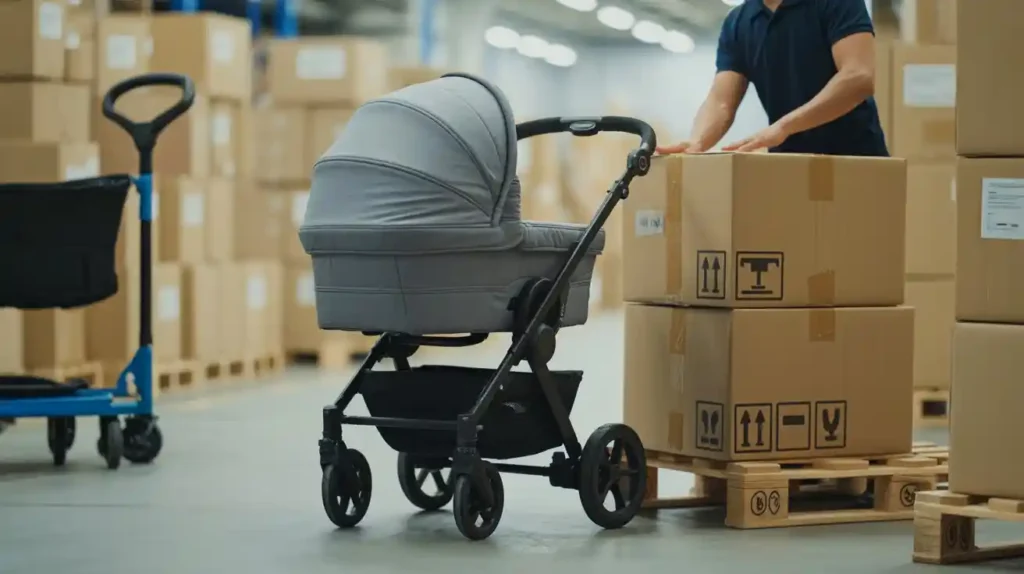
Shipping baby gear can feel overwhelming, especially when dealing with bulky items. Many people assume delivery fees are based solely on weight, but the container’s physical size often plays a much bigger role in your final invoice due to dimensional weight. If you are preparing a package, you are likely wondering: how much does it cost to ship a stroller? Prices vary based on dimensions and distance.
At Bearcat Express, we provide transparent logistics to help everyday shippers navigate carrier networks, master practical packing strategies, and avoid unexpected hidden surcharges so you never overpay.
Quick Answer: The True Cost to Ship a Stroller
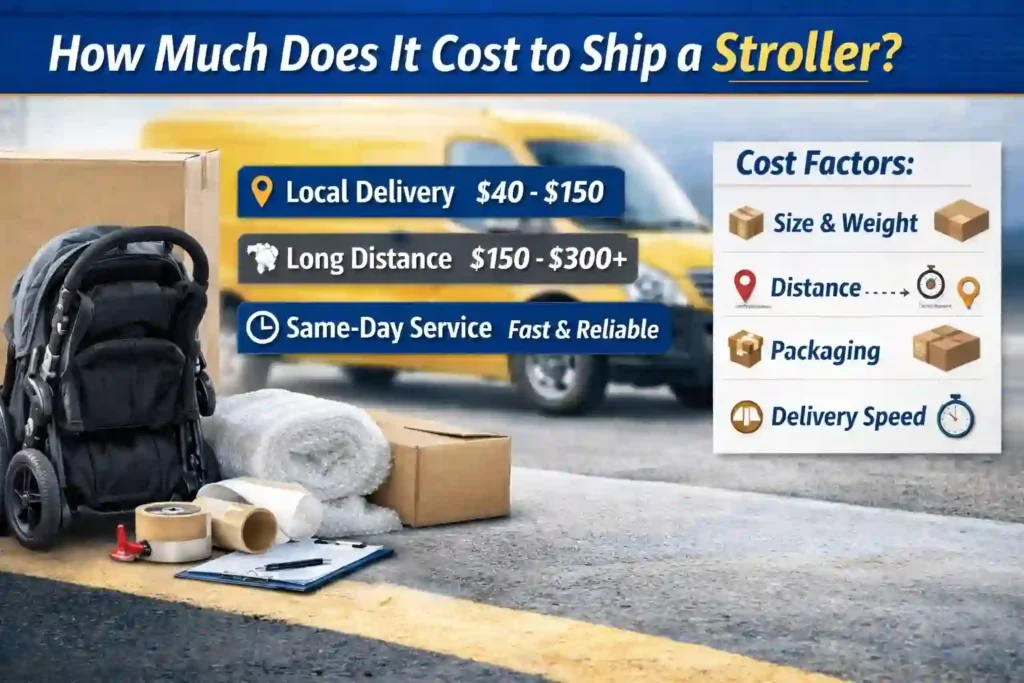
If you are looking for a quick baseline estimate, domestic ground shipping for a stroller generally ranges from $15 to $150+. If you require expedited or overnight delivery, expect that price to jump anywhere from $60 to $350+. For families or businesses sending items across borders, international shipping typically starts around $100 and can easily exceed $350 depending on the final destination, duties, and brokerage fees.
The reason these price windows are so wide comes down to a concept called dimensional weight, alongside regional zone structures. A compact umbrella stroller packed tightly into a slender box costs significantly less to transport than a dual-seater jogging stroller that requires a massive, heavy-duty carton.
Crucial Factors That Determine Your Shipping Cost
To get an accurate estimate, you have to look at how major logistics networks view large, irregular packages. Carriers do not just look at a scale; they look at how much physical space your parcel occupies in the back of a delivery truck or cargo plane.
Dimensional (DIM) Weight Pricing Explained
Dimensional weight is a pricing technique used by commercial carriers to calculate billing rates based on a package’s volume rather than its actual weight. The industry standard formula used to determine this is:
$$\text{Dimensional Weight (lbs)} = \frac{\text{Length} \times \text{Width} \times \text{Height (inches)}}{139}$$
If the resulting dimensional weight is higher than the actual physical weight on a digital scale, the carrier bills you for the larger dimensional figure.
Real-World Scenario: Imagine you are shipping a premium standard stroller that weighs exactly 15 pounds. Instead of finding a snug box, you place it fully assembled into a massive carton measuring 36″ x 24″ x 22″. When you apply the carrier formula, the calculation looks like this:
$$\frac{36 \times 24 \times 22}{139} = \frac{19,008}{139} \approx 136.7\text{ lbs}$$
Even though your item only weighs 15 pounds, the carrier will bill you at the 137-pound rate. This single oversight can instantly turn a routine shipment into an incredibly expensive logistical nightmare.
Stroller Type and Actual Weight
While size dictates the baseline, physical mass still sets the minimum price tier.
- Umbrella Strollers: These minimalist models usually weigh between 10 to 15 pounds. Because they fold into long, slender shapes, they can easily slide into narrow boxes that keep both physical and dimensional weight low.
- Standard Full-Size Stroller Systems: Ranging from 20 to 30 pounds, these units require wider boxes to accommodate sturdy frames, larger wheels, and built-in storage baskets.
- Double, Jogging, or Tandem Strollers: These are the heaviest and bulkiest items in the category, weighing anywhere from 30 to 45 pounds or more. They feature wide wheelbases and reinforced shock-absorption systems, meaning they almost always trigger high dimensional weight pricing and oversized box fees.
Shipping Distance and Zone Systems
Domestic carriers break countries down into geographical shipping zones, typically ranging from Zone 1 to Zone 8. Zone 1 and Zone 2 represent local addresses closest to the point of origin, while Zone 7 and Zone 8 represent cross-country or transcontinental destinations.
The further your package travels across these zones, the higher the cost. Shipping a standard full-size stroller within the same state might cost you $35, whereas sending that identical box across multiple time zones can easily push the baseline ground price up to $85 or more. For urgent, regional needs within specific commercial centers, leveraging a localized Same Day Delivery Service Augusta GA can help circumvent complex national zone pricing models while ensuring your cargo arrives securely on a compressed timeline.
Carrier Surcharges and Additional Handling Fees
National carriers regularly tack on auxiliary fees for items that do not fit seamlessly onto automated sorting conveyor belts. If your stroller box exceeds certain length or girth thresholds, you will face an Oversized Package Fee or an Additional Handling Surcharge.
Furthermore, delivering to a residential home rather than a commercial warehouse or retail storefront automatically triggers a Residential Delivery Surcharge. If you live in a remote area or a high-density urban center with restricted parking, extra fuel and delivery access surcharges may be applied to your final bill.
You may also read: What Does Delivery Attempted Mean?
3. Step-by-Step Guide: How to Pack a Stroller to Cut Costs by 30%
Knowing how to ship a stroller efficiently comes down to minimizing the total volume of your packaging. Taking the time to properly pack stroller frames saves money by lowering your dimensional weight profile. Follow this systematic approach to secure your item while protecting your wallet.
Step 1: Deep Clean and Take Photos
Before you begin breaking down or wrapping, thoroughly clean the entire stroller. Wipe down the aluminum frame, vacuum out any crumbs from the fabric seats, and wash off dirt or debris from the rubber tires. Once clean, take clear, well-lit photos of the stroller from multiple angles. This step establishes documented proof of the item’s pristine condition should you ever need to file an insurance claim for transit damages.
Step 2: Complete Disassembly
To minimize the dimensions of your final stroller box, you must break the unit down into its smallest possible components. Remove all quick-release wheels, detachable sun canopies, parent trays, child bumper bars, and cup holders. Stripping these accessories away allows the core metal frame to fold down completely flat, drastically reducing the required depth and width of your shipping container.
Step 3: Secure and Wrap Individual Parts
Place loose hardware, screws, or small plastic clips into a clear, sealable plastic bag and tape it securely to the primary frame. Wrap the removed wheels, snack trays, and sensitive frame joints in layers of heavy-duty bubble wrap or foam sheeting. Use plastic stretch wrap or zip ties to bind the main folded frame together tightly, ensuring it cannot accidentally pop open or shift around inside the box during transit.
Step 4: Box Optimization
Avoid the temptation to use a random oversized box stuffed with crumpled newspaper. Seek out a heavy-duty, double-walled corrugated cardboard box specifically sized for flat items or golf clubs. If an exact fit isn’t available, buy a slightly larger box and telescope or modify the edges down to eliminate space.
Step 5: Seal, Weigh, and Label
Fill any residual small gaps with packing peanuts or air pillows so the frame cannot slide around. Close the box flaps and seal all seams using the H-taping method with high-quality, 2-inch-wide packing tape. Avoid weak masking or duct tape. Finally, use a home scale and tape measure to record the exact weight and external dimensions so you can print your shipping labels with total confidence.
Shipping a Stroller vs. Traveling With It
For parents preparing for a major family trip, deciding whether to check their baby gear with an airline or coordinate courier transport ahead of time is a common dilemma. Both methods offer distinct pros and cons regarding cost, safety, and convenience.
Airline Baggage Fees vs. Courier Shipping
Most commercial airlines allow passengers to check a stroller and a car seat directly at the ticket counter or at the boarding gate free of charge, as they do not count toward your standard checked baggage allowance. From a purely financial standpoint, gate-checking is usually the cheapest route. However, if you are traveling with a massive double-stroller system that exceeds airline gate size allowances, some carriers may force you to check it as oversized luggage, resulting in steep fees ranging from $30 to $150 per flight leg.
The Convenience Factor
Trudging through a bustling airport terminal while managing luggage, tickets, and small children is inherently exhausting. Pushing a heavy stroller through security checkpoints only to dismantle it at the boarding gate adds a layer of travel friction. Utilizing a professional logistics approach allows you to ship your stroller directly from your doorstep to your destination hotel or rental home, letting you travel light through the airport terminal.
Damage Risk and Protection
Airlines are notorious for rough baggage handling. Gate-checked strollers are frequently tossed into cargo holds unprotected, leaving them vulnerable to bent frames, torn fabric, and broken plastic joints. When you carefully pack stroller units inside a rigid, padded box and ship them through a reliable network, your gear benefits from structured structural protection and comprehensive transit tracking.
International Stroller Shipping: Hidden Costs to Watch Out For
Sending a baby carrier across international borders involves navigating global trade regulations. While standard international shipping rates for oversized parcels regularly range from $100 to $350+, the base freight price is rarely the final cost.
When a large package enters customs clearance, the destination country assesses duties and import taxes based on the declared value of the item. Additionally, private couriers often charge automated customs brokerage fees to process the paperwork on your behalf. If you do not explicitly clear these fees upfront via a Delivery Duty Paid (DDP) service, the recipient will be forced to pay these extra fees out-of-pocket before the package can be successfully dropped off at their door.
Insider Tips to Save Money on Stroller Shipping
- Avoid Retail Counter Rates: Walking directly up to a retail shipping counter to purchase a label on-the-spot is almost always the most expensive route. Instead, utilize online shipping software and discount aggregators to access commercial contract rates, which routinely save you 30% to 50% off the standard consumer pricing tiers.
- Opt for Ground Transit: Unless you are facing an urgent emergency, completely steer clear of air freight, overnight, or express options. Strollers take up too much physical volume, meaning air transport pricing escalates rapidly. Planning a week and selecting economy ground shipping keeps costs manageable.
- Repurpose the Original Box: If you still have the manufacturer’s original cardboard box tucked away in a garage or closet, use it. Factory packaging is engineered to hold the stroller in its most compact configuration, ensuring you do not waste money on excess dimensional volume or filler material.
Conclusion
Shipping a stroller safely without spending a fortune requires a clear understanding of package dimensions. By keeping the box size down and planning, you can avoid the hidden fees of dimensional weight pricing.
Before taping up your package, review this quick final checklist:
- Is the box size optimized to remove space?
- Are the wheels, canopy, and trays detached and wrapped?
- Have you taken photos for your records?
- Are all labels secured with heavy-duty packing tape?
If you want a reliable and direct logistics experience, let the team at Bearcat Express handle your transport needs. Please feel free to contact us today to get a precise, custom quote tailored to your specific destination.
Frequently Asked Questions
What is the absolute cheapest way to ship a stroller?
The most cost-effective method is to dismantle the stroller completely, pack it tightly into a highly optimized, low-profile box, and purchase an economy ground shipping label through an online discount shipping platform. Avoiding retail walk-up counters and choosing standard 3 to 7-day ground transit keeps your out-of-pocket expenses to a minimum.
Can I ship a stroller without putting it in a box?
While you can technically wrap a stroller in heavy layers of plastic shrink wrap, doing so is highly discouraged. Most major courier networks will reject raw or unboxed items entirely, or hit you with an expensive non-standard packaging surcharge. More importantly, soft packaging offers no structural protection against heavy falling parcels inside a delivery truck, risking severe frame damage.
Does shipping insurance cover damage to strollers during transit?
Yes, standard shipping insurance covers transit damage, provided you can prove the item was packed correctly according to the carrier’s official guidelines. To ensure a successful claim, you must document the condition of the stroller with clear photos before packing and show that the box used was strong enough to withstand standard automated sorting systems.
How much does it cost to ship a double stroller cross-country?
Shipping a double or jogging stroller long-distance generally costs between $80 and $160+ via standard ground transit. Because these models feature wider wheelbases and heavier frames, they require larger boxes that naturally trigger dimensional weight pricing along with oversized handling surcharges.